Travel
Chiang Rai – Top best things to see and do
Destinations

Joanna Horanin
Current condition

Weather in Chiang Rai
Light rain shower
Temperature
Feels like 26.3℃ 😎
UV index
Low
Air quality index
Good
Last updated at 10/09/2026, 19:15
Hi, I'm Joanna, the author of The Blond Travels. In the worlds of Thailand and Portugal, I feel like a fish in water - and it's no coincidence! I've been exploring Thailand for over a decade, and I've settled in Portugal for 6 years now. My mission is to support Dreamers - just like you - in discovering these fascinating countries and helping those in love with them find their own place on Earth, preferably for good! Let's uncover these unique corners of the world together.
- Chiang Rai Quick Facts
- Temples
- Sightseeing the city
- Views and nature
- Your plan of things to see and do in Chiang Rai
- Is it worth visiting Chiang Rai?
- When to visit?
- How to get there?
- Accommodation
- What and where to eat?
- Frequently Asked Questions About Chiang Rai
I couldn’t believe I was in Chiang Rai again. The last time I had visited this place was when I first moved to Thailand, which was over 13 years ago. Back then, with a group of friends, we rented a car and headed further north from Chiang Mai. At the time I wrote a blog post in English about driving to Phu Chi Fa, which I recently had to correct because it was a proof of how little I still knew about Thai culture. Today I’m taking you on a sightseeing tour. I’ll give you a hint of what to see in Chiang Rai in northern Thailand, where spirituality is indivisibly linked to art and where you’ll see one-of-a-kind buildings.
I went to Chiang Rai for the weekend. I arrived late in the evening, when the night market had already opened on the main street. Somewhere in the distance I could hear traditional Lanna music. The street led me past food stalls, smiling vendors and a couple of bars, tempting me with a cold beer. Before heading to the hotel, I sat in the main square, in front of a stage with Thai dancers swaying to music. Beautifully dressed in Lanna costumes, smiling slightly, graceful, they seemed to almost flow in the air.
I already had a plan, I knew what to see and do in Chiang Rai, but then in the evening I sat down once again to check exactly where to go for the next 2 days. Later it turned out that I had to change that plan, but I had a super weekend in Chiang Rai. I’ve put together an itinerary of sights and attractions for you to have an unforgettable time there as well.
Chiang Rai offers quite a few attractions in the city itself. There are many temples, very unusual and unique. In addition, there is also a market, the so-called walking street, a bit of good coffee and tea stores. One whole day is enough for things to see and do in Chiang Rai, but you can also combine it with an overnight stay and go further into the mountains.
Chiang Rai Quick Facts
- Distance from Chiang Mai: 200km (2-2.5 hours)
- White Temple entrance: 100 THB
- Black House entrance: 80 THB
- Blue Temple: Free entry
- Best time to visit: December-March
- Recommended stay: 1-2 days – Population: 200,000
Explore Thailand With a Local Guide
I book my tours through TakeMeTour — small-group and private experiences led by local guides who actually know the area, not a script. It’s how I find the spots most tourists never see.
Browse Tours on TakeMeTour →Affiliate link — booking through it supports the blog at no extra cost to you.
Temples
Wat Rong Khun – The White Temple
I got here first thing in the morning, hoping to beat the crowds. It was already busy by the time I arrived, but not overwhelming. I managed to find a few quiet corners to ourselves, and even took the crowds into account, it’s worth planning around 2 hours here, which is roughly how long we ended up staying.an to visit this part of Thailand comes.
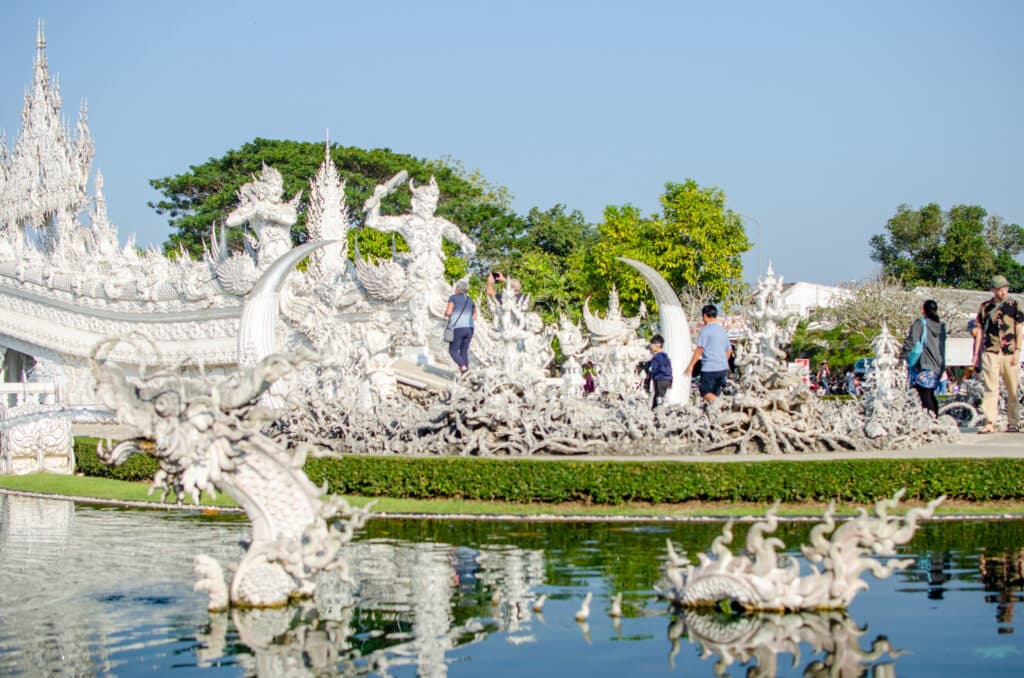
The White Temple in Chiang Rai was built by Thailand’s famous artist Chalermachai Kositpitat. The entire building was opened to the public in the 1990s. Up to now, renovation and finishing works are still going on.
The front of the temple is what everyone photographs, and it’s every bit as striking in person. But don’t skip the back as it’s covered in fragments of glass that catch the sun and shimmer as you walk around it, and we actually preferred it to the front. Inside, the walls are covered floor to ceiling with murals mixing traditional Buddhist imagery with comic book and superhero characters -it’s genuinely surprising the first time you see it, and not something photos of the exterior prepare you for. There’s also a small artificial cave on the grounds where the artist has recreated his own vision of hell and heaven – easy to miss if you’re only doing the main building, but worth the extra ten minutes.
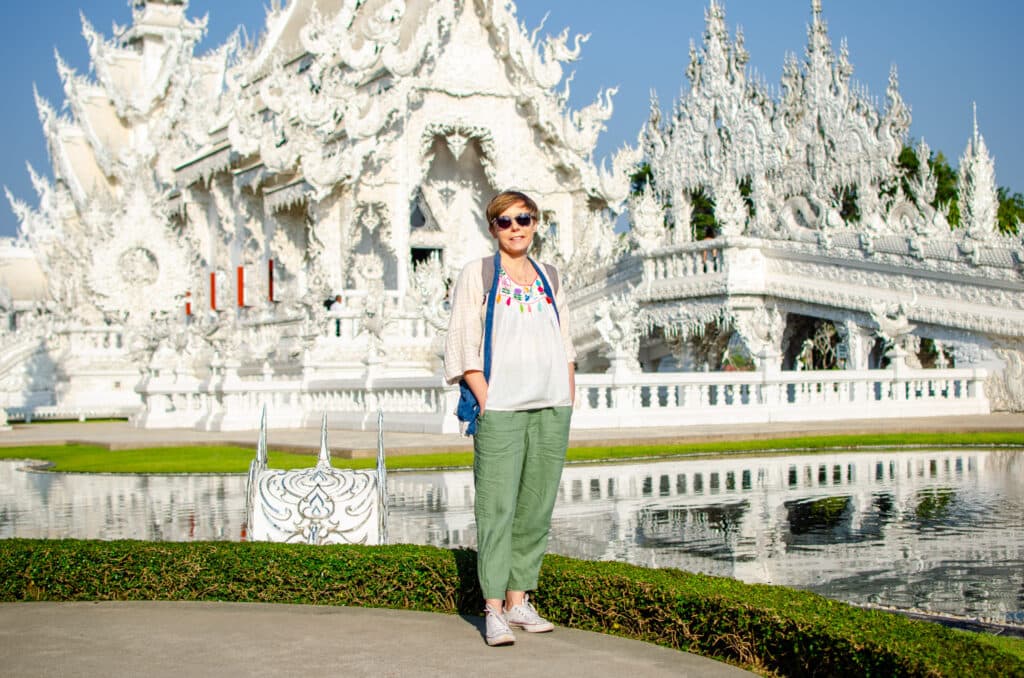
The entire temple looks like something out of a fairy tale. The main building is a small chapel, which is covered with sculptures, white paint and crystals that glimmer in the sun like diamonds. A bridge leads to it, under which sinners from hell reach out for help. After crossing, you enter the fantastically finished interior of the temple.
Behind the main building you will find another, equally beautiful. Both structures stand in gardens, contrasting in their greenery with the rest of the complex.
Wat Rong Khun is open to the public from 8:00 am. It’s worth getting there early to avoid the full sun. There are always plenty of tourists here, regardless of the time.
Admission is THB 100 per person.
Wat Rong Suea Ten – The Blue Temple
Compared to the White Temple, this one is a much quicker stop – we spent about an hour here, it wasn’t very crowded, and the temple itself is small enough that you can see everything without rushing. If you’re short on time in Chiang Rai, this is the easier of the two to fit in.
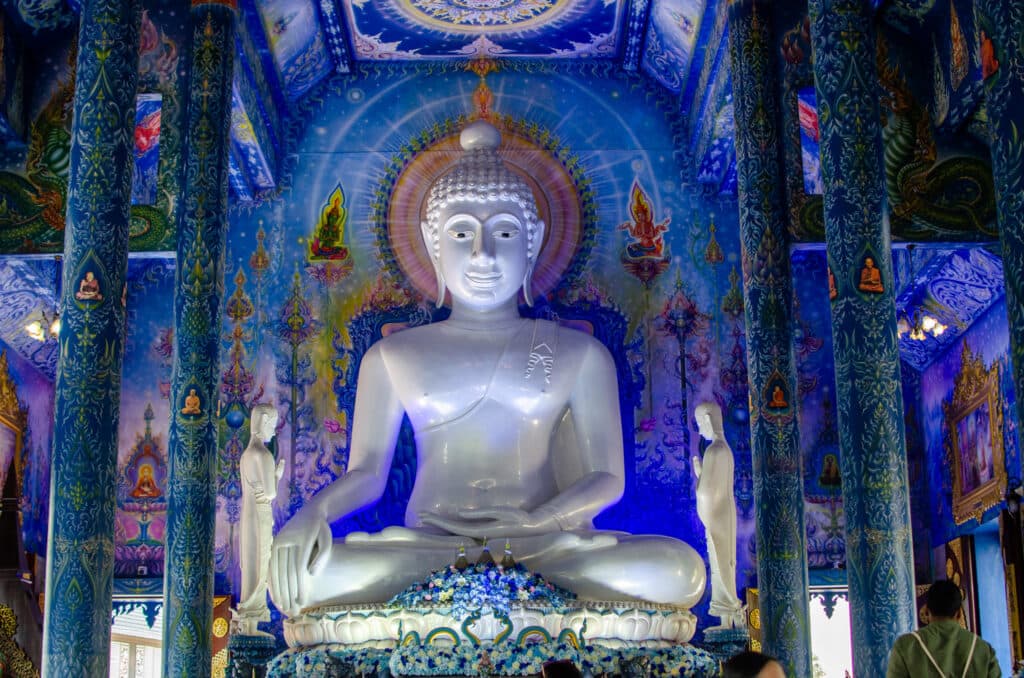
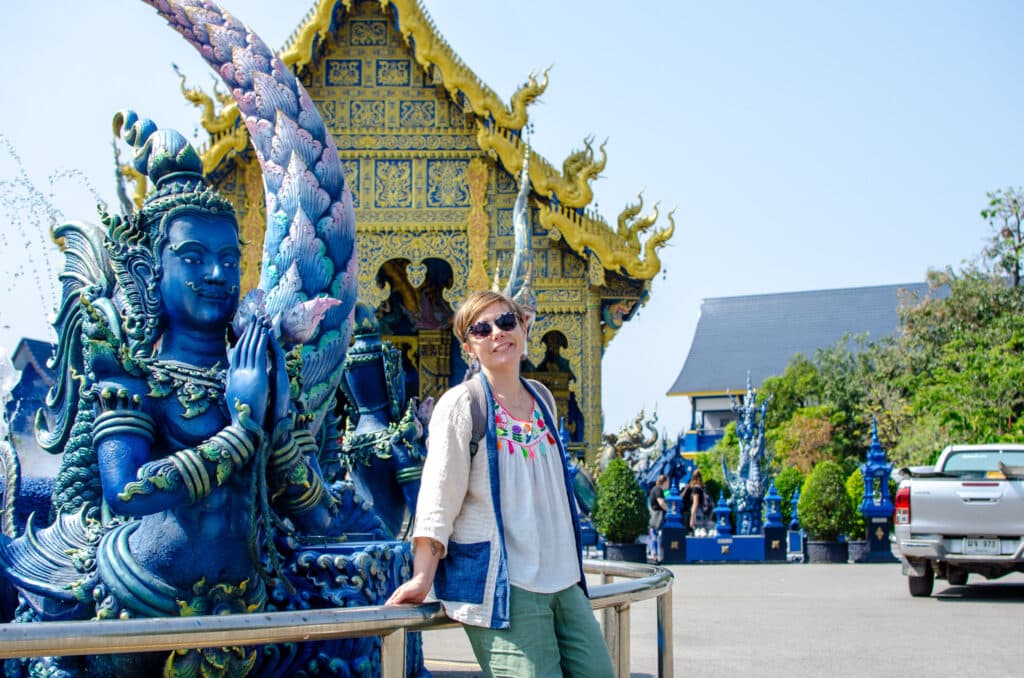
In the square out front, there’s a fountain with a Buddha sitting in lotus pose, surrounded by the deities protecting him – a nice spot to pause before heading up the steps to the main building, which are guarded on either side by Naga, snake-like dragon figures common in Thai temple architecture.
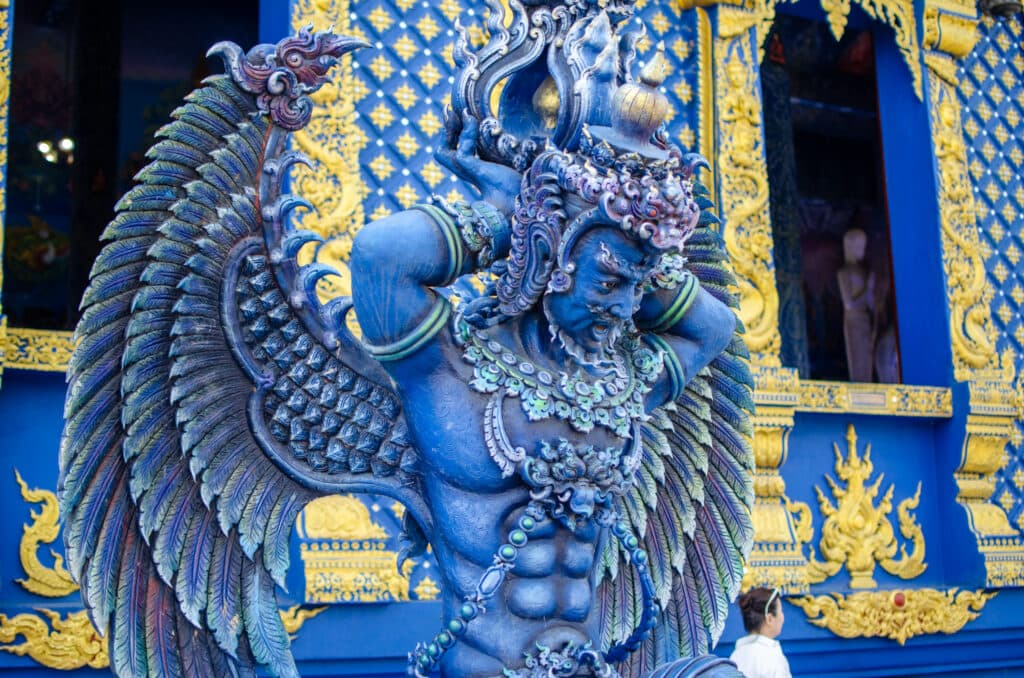
Step inside and the color shift is immediate – everything is blue, almost cosmic, somewhere between a temple and a planetarium. A large, striking Buddha sits at the center, and rows of blue angel figures line either side of the hall. It’s a strange, beautiful contrast to the white and gold you’ll see almost everywhere else in Chiang Rai.
On each side of the Blue Temple are lined up beautiful angels, which of course are also blue.
Admission is free.
Tip: Because it’s smaller and quicker to visit than the White Temple, this pairs well as a same-morning stop before or after – I found it easy to fit both into one trip without feeling rushed.
Wat Huay Pla Kang – 3 temples in one place
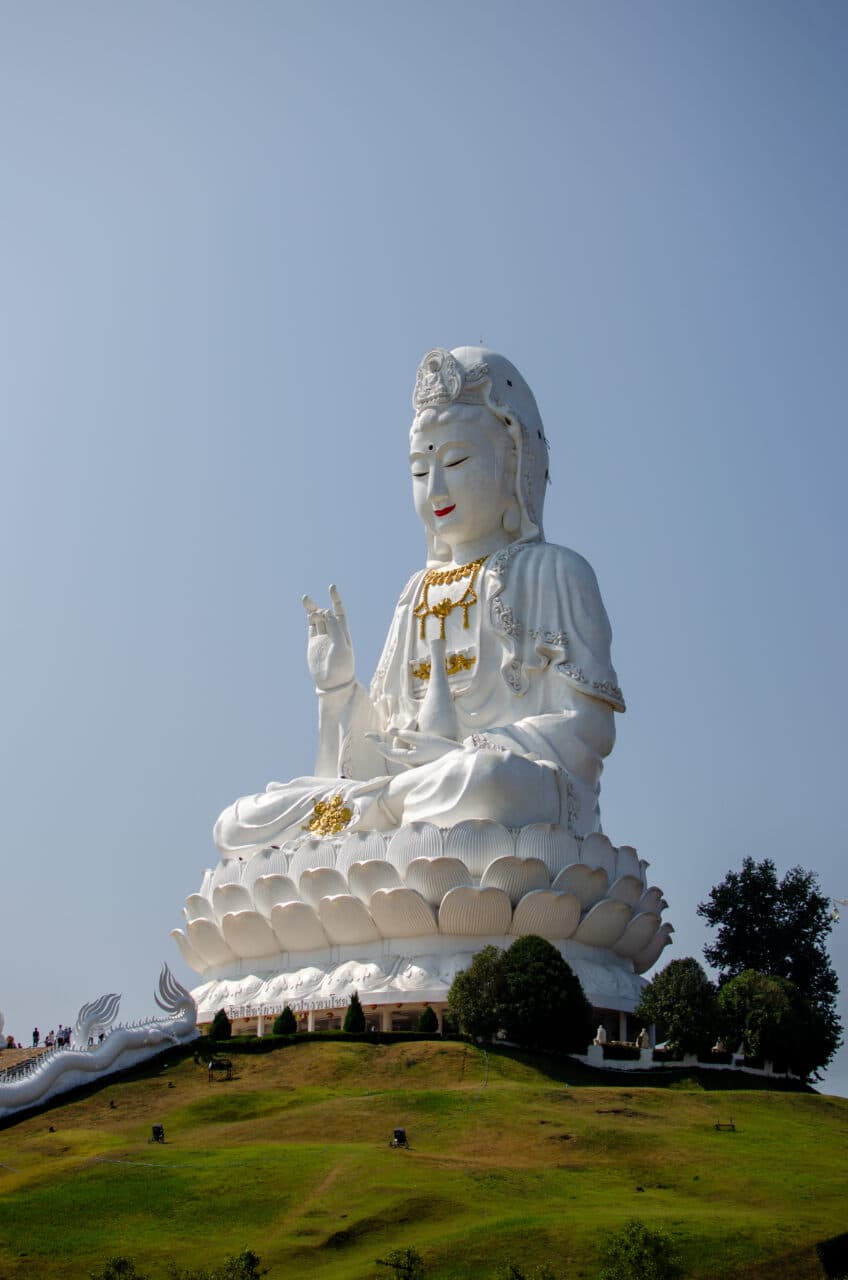
Haven’t had enough of temples yet? If so, let’s head to Wat Huay Pla Kang. It is a complex with 3 temples, dedicated to the Goddess of Grace. Its biggest attraction is the huge Buddha statue, and the pagoda, which is 9 stories high.
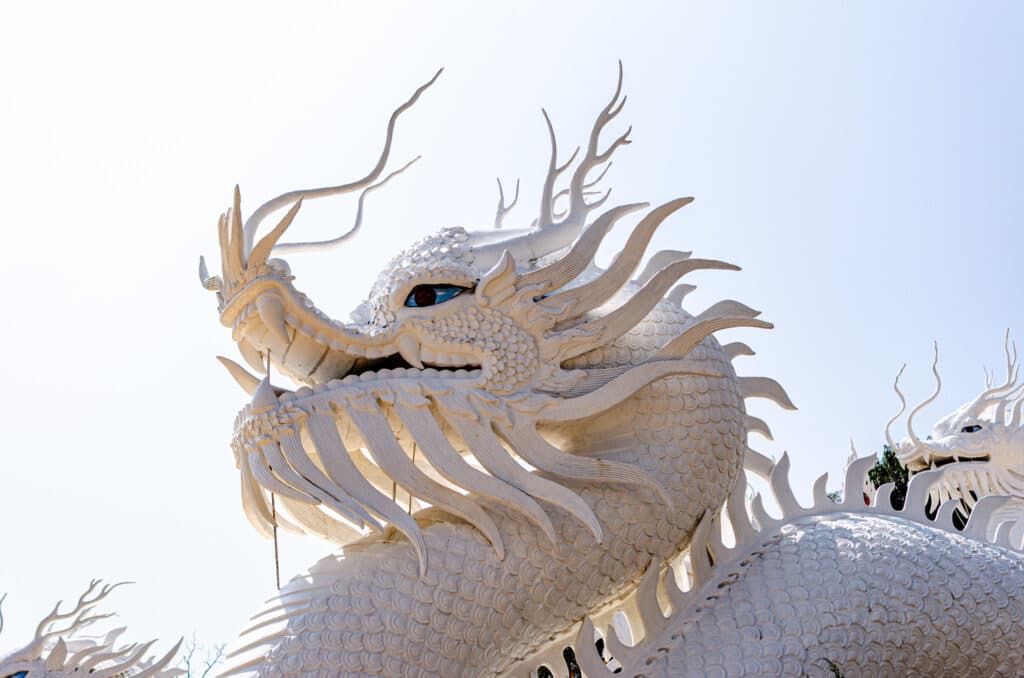
I will honestly say that this was probably my least favourite place to see and do in Chiang Rai. Thailand keeps building these kinds of complexes to attract not only the faithful, but also tourists. I, for one, had the impression that I was in a Thai Fatima. Somehow the place did not captivate me. On the other hand, if it’s on your list of places you want to see in Chiang Rai, why not? I think it won’t hurt to come here and see if you will enjoy it.
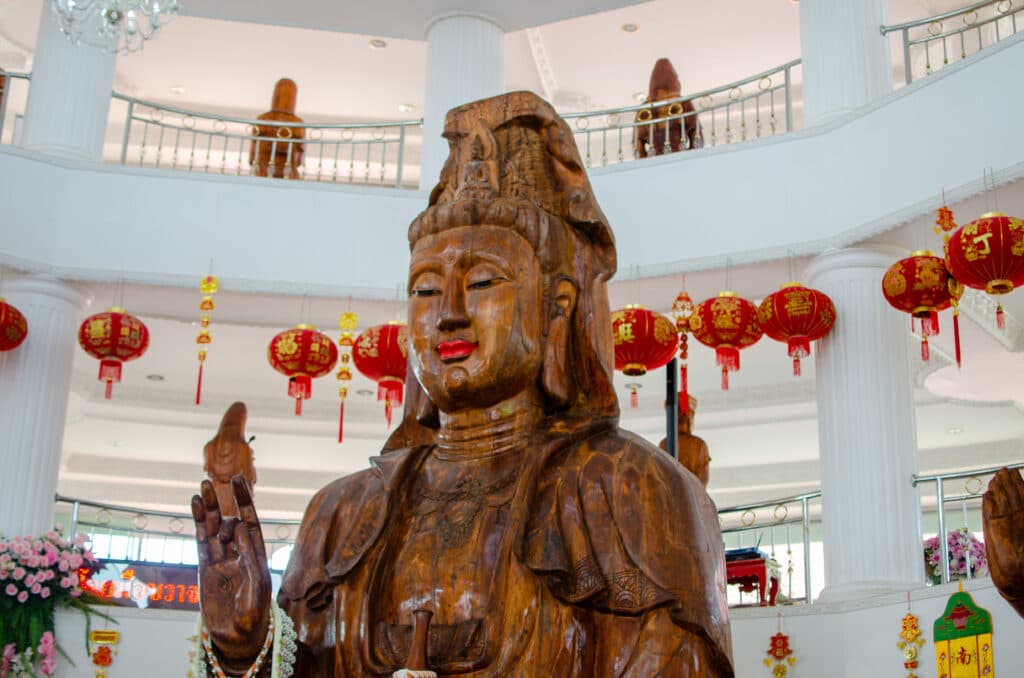
I arrived at a hill, on top of which there was a tall Chinese – looking pagoda. This is Phop Chok Dhamma Chedi, which blends traditional and modern architecture. In front of it, you’ll find burning incense, where pilgrims come to pray. Inside the chedi, there is a replica of the Guan Yin carved with fragrant wood.
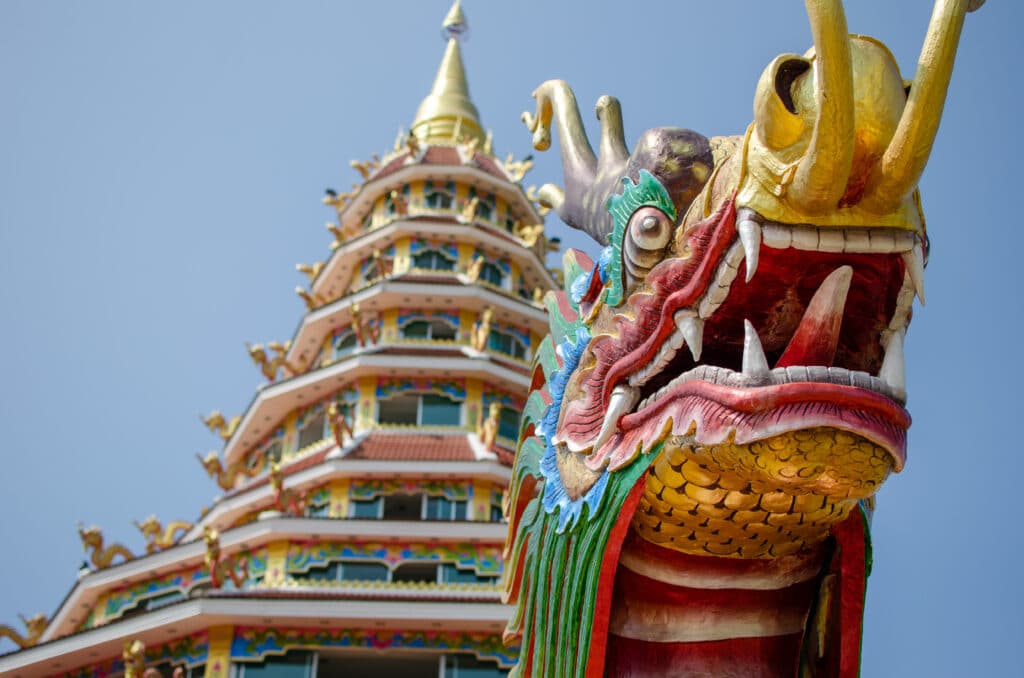
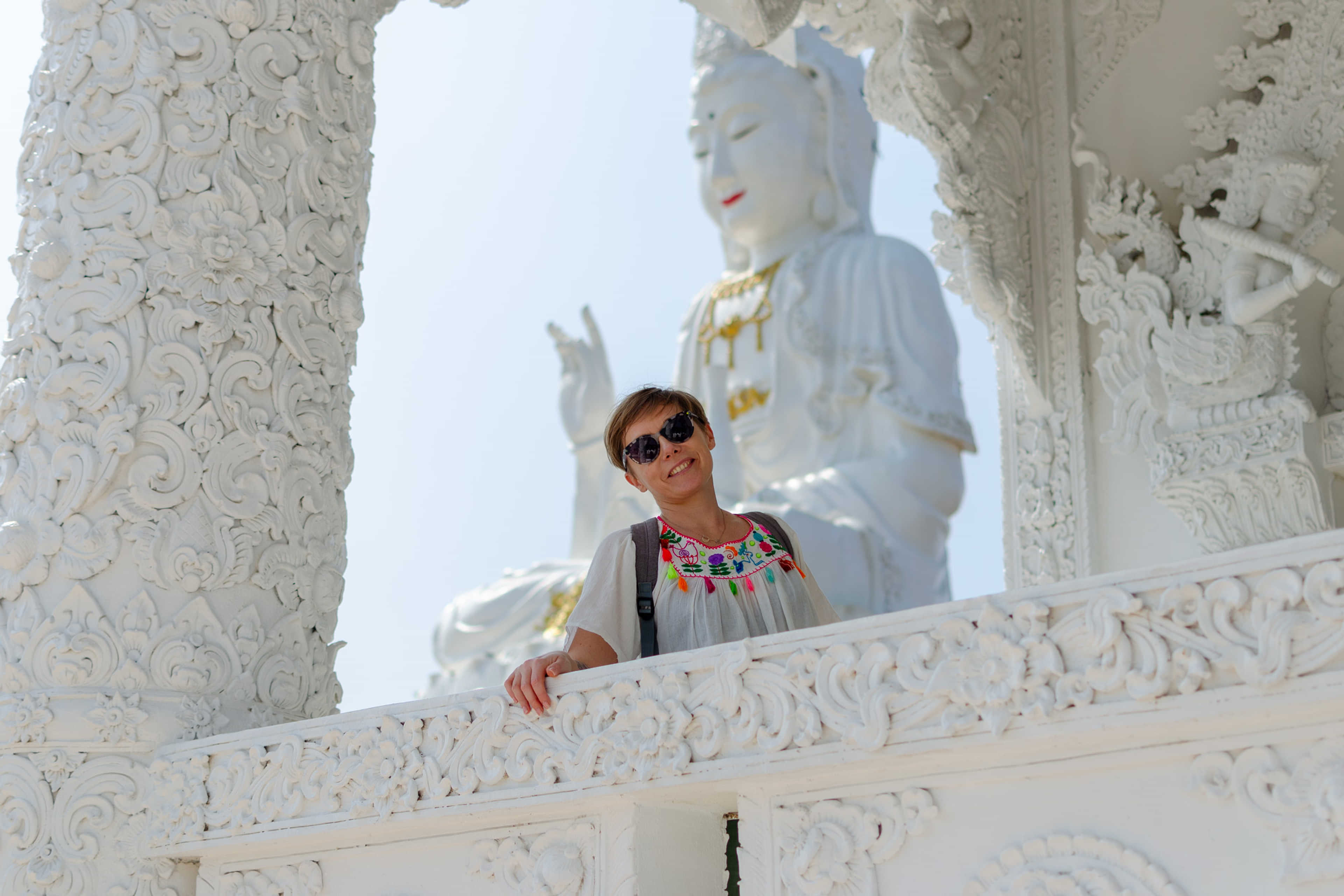
The most popular feature in this complex are the Naga stairs. Two huge white dragons on both sides lead to the temple. They are probably the most photographed. I was there during the day, so didn’t have the opportunity to see them in a different light, but during the sunset they are even more beautiful. In the day light they are almost blinding and still make a great impression on visitors.
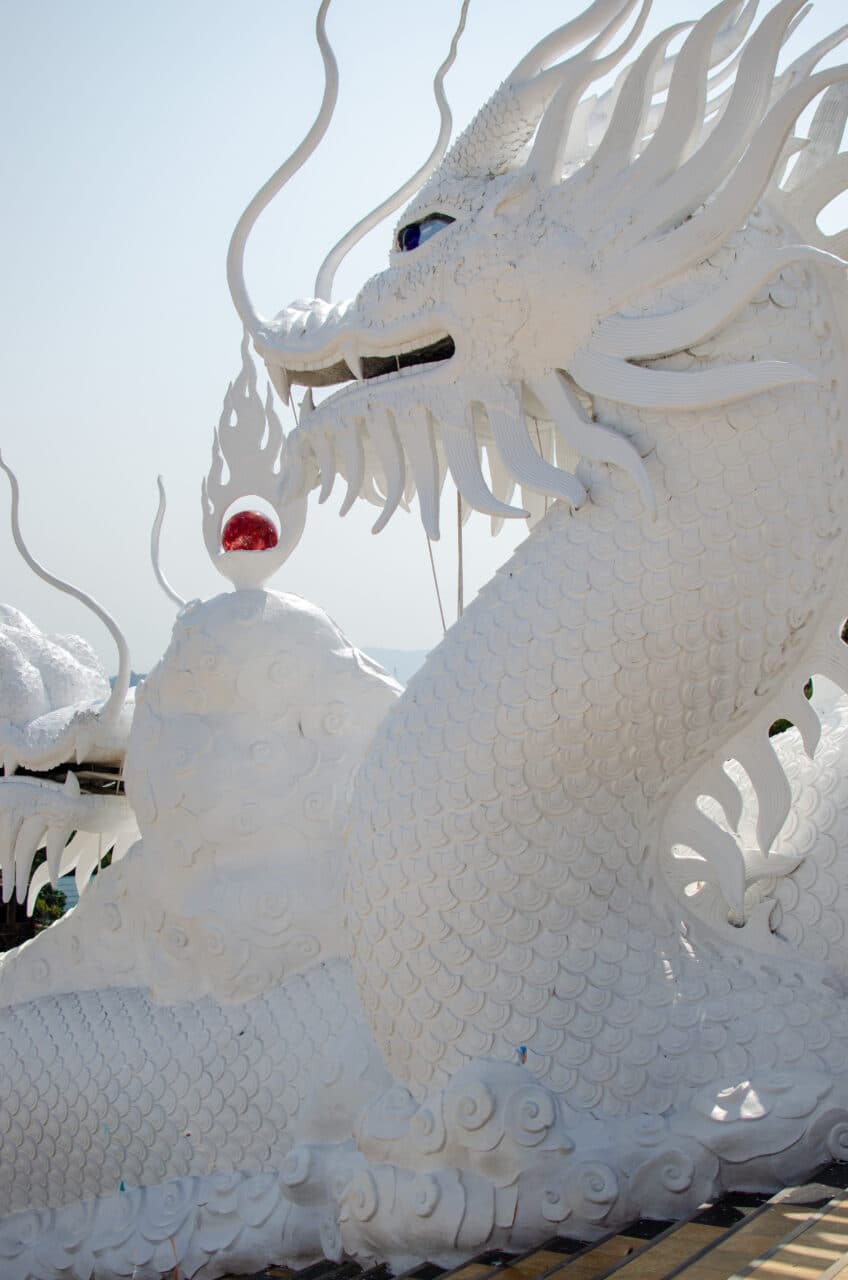
The last of the complex is the giant Guan Yin statue. It measures over 79 meters in height and offers nice views over the area. When you enter inside, you’ll be able to use the lift to go upstairs. It costs 20 THB per person. On the upper floor, except the views, you’ll find sculptured walls and ceilings.
Admission to all the temples is free. (I found information online that it costs 40 THB, but I entered without paying. I’m not sure if this was my mistake or the sources online say something that is no longer true. Worth checking at the entrance gates.)
Baan Dam – The Black House
When I first visited Baan Dam 10 years ago, it was a single house standing alone in a large forest. Today, it’s grown into a sprawling complex of more than 40 smaller and larger buildings.
Despite the name, this isn’t a temple, though the architecture borrows heavily from traditional Thai wat design, and a few of the buildings do house Buddha statues. It’s actually an art gallery, showcasing the work of artist Thawan Duchanee alongside pieces from other artists around the world.
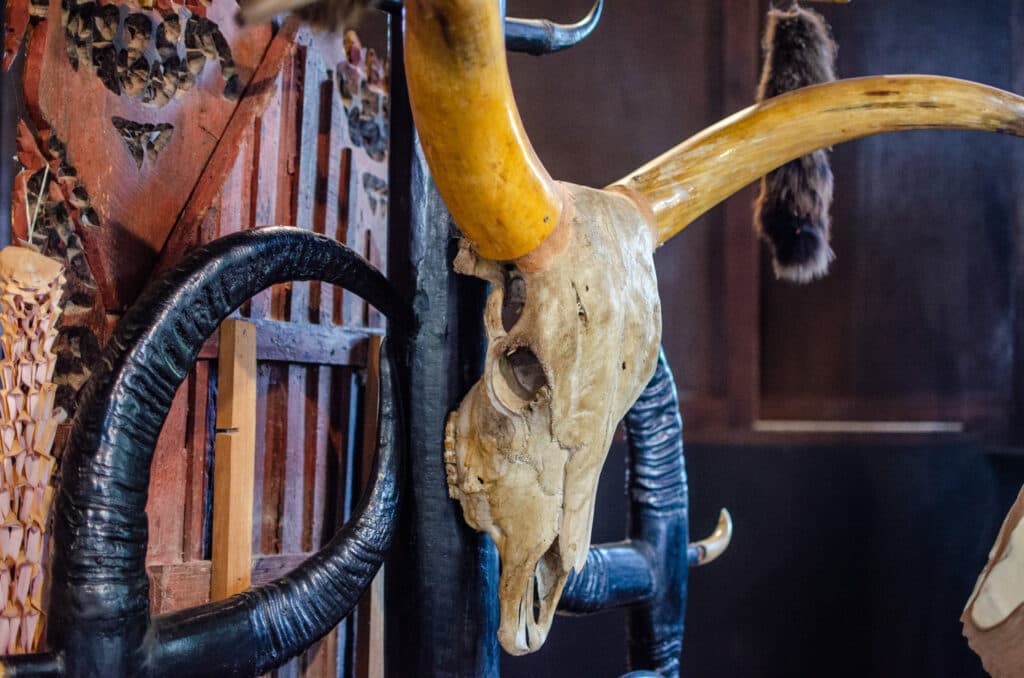
Every building is black wood, and the collection inside is as unusual as the setting: in the main room, alongside the paintings, there’s a long table covered in crocodile skin, chairs built from animal horns and bones, and furniture draped in animal hides. Some of the buildings genuinely felt creepy – but that’s exactly what made them fascinating rather than off-putting, and I found myself wanting to see every single one.
We spent around 2 hours walking the grounds, and one thing I really appreciated is that because the site is so spread out, it never feels crowded the way some of Chiang Rai’s other attractions can, even with other visitors around, you rarely feel like the crowds are interrupting your sightseeing.
Baan Dam is open from 9:00 am and admission costs 80 THB.
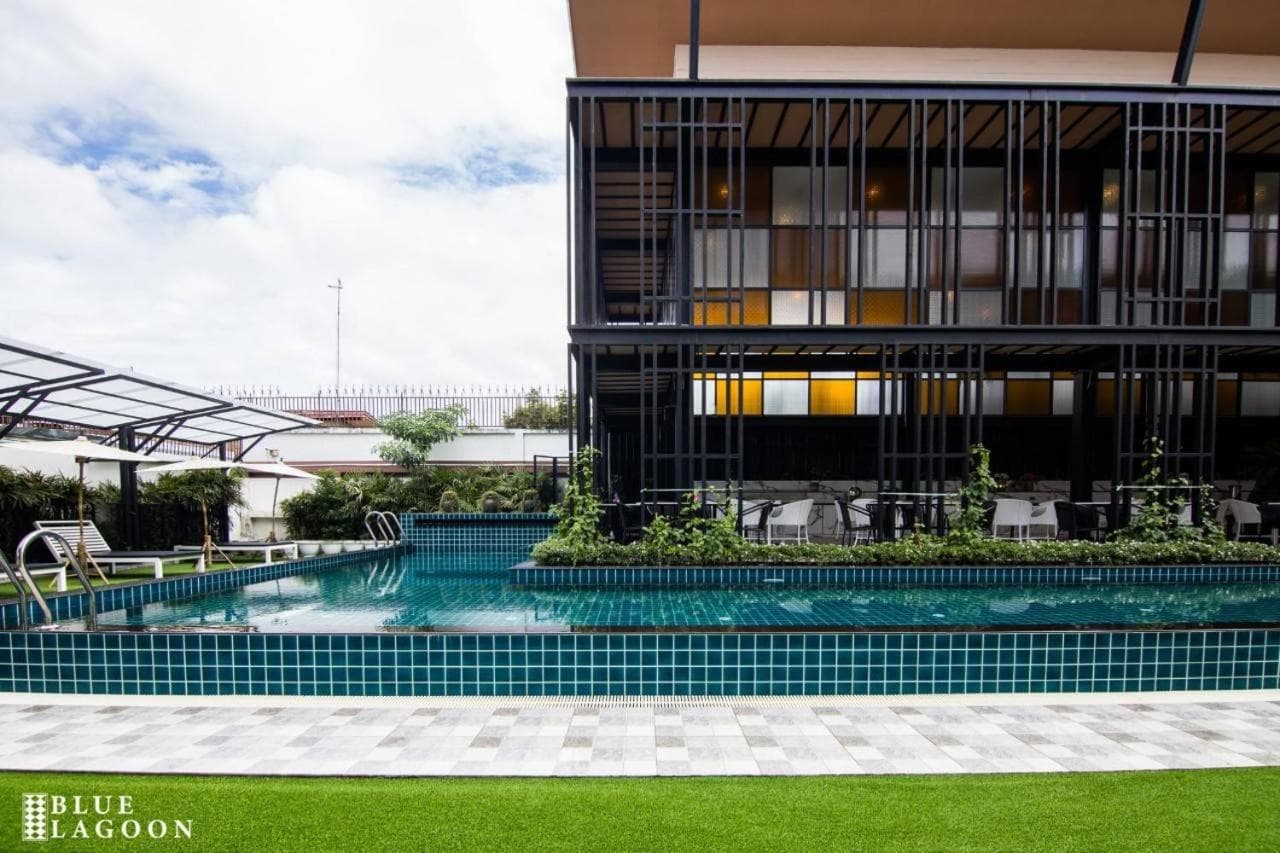
Featured Hotel: Blue Lagoon Hotel – Great location, clean and spacious rooms. The pool is a great addition. Rate starts from $20 per night. Book your room here.
Sightseeing the city
The Clock Tower
In the middle of the main roundabout in Chiang Rai stands a huge golden clock. During the day it appears to be total kitsch (my own feelings). During the evening it is a bit more attractive, as it is illuminated by colored lights.
It’s hard to say entirely whether the clock is beautiful. It can certainly appear to be so. It is certainly an attractive design.
It was made by Chalermachai Kositpitat, the same one who created the White Temple. The artist is known for his fantastic visions and here, too, he certainly showed his creativity. The clock in Chiang Rai is definitely worth seeing, even if you think you don’t like it at all.
The Walking Street
I went in the evening, just after dark, when the food stalls line up along the main street through town. It stretches along one main road but spreads out into the side streets as well, so there’s more to explore than it first looks like.
I stopped and ate tom yum goong from one of the stalls, and food in general was cheap — most snacks and dishes ran between 20 and 60 THB. I didn’t end up buying anything else, but there’s plenty of souvenirs and clothing on offer if that’s what you’re after, and just browsing was part of the fun.
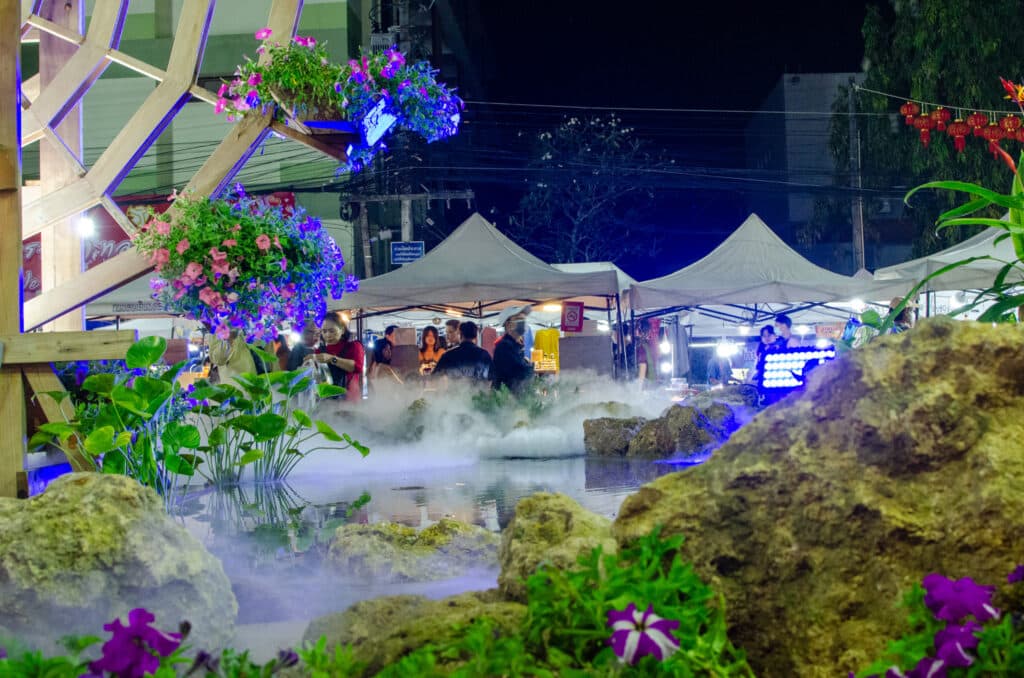
The night I visited happened to coincide with a flower festival, so the main park was packed and there was a live concert going on -the streets around the stalls were completely full of visitors. That’s not necessarily what you’ll get every night, but it gives you a sense of how busy it can get when there’s an event on.
Tip: Go after sunset, and if you’d rather avoid the heaviest crowds, plan to head out by around 8-9pm — it only gets busier from there, especially on weekends.
Views and nature
Tea plantations
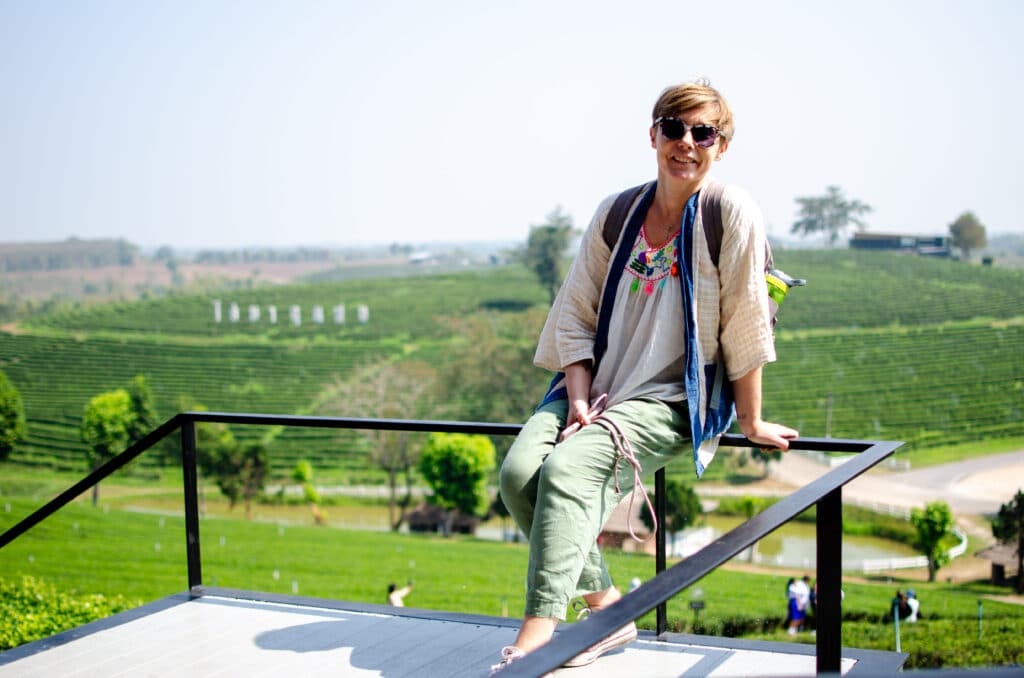
If you’re wondering what to see and do in Chiang Rai, besides the temples, it will definitely be the coffee and tea plantations. It only takes about 3-40 minutes to find yourself in a tea field near Chiang Rai. Driving into its grounds, it seems as if one has suddenly found oneself in Portugal or another country in Europe. The fields here are beautifully landscaped.
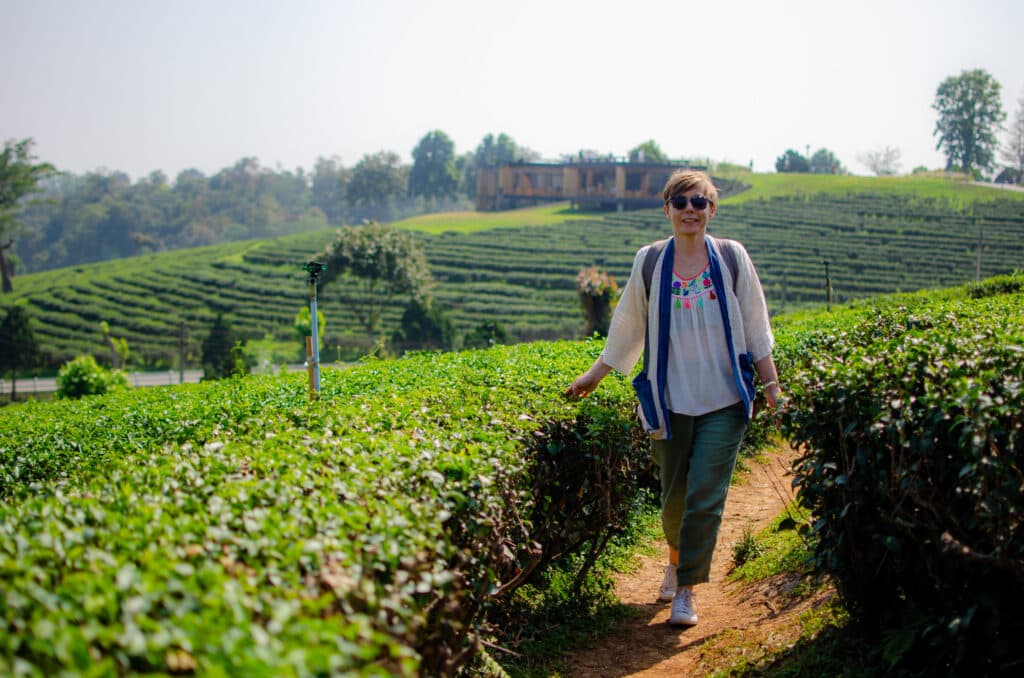
I drove there on a scooter from Chiang Rai. The road was very busy and some drivers weren’t very careful. At one point I almost had an accident. Be careful, if you have your own transport!
When I arrived, it was around noon, I sat down in the cafe and ordered a tea and a piece of matcha cake. Both were absolutely delicious. I had a nice table, on the view point, where where I could see the plantations. There was a decent crowd around, but everyone was spread out and it didn’t feel claustrophobic. At the back of the cafe there is a view point and there you can take nice photos.
After relaxing, I went to the souvenir shop and bought myself a couple of bags of tea. Some were for presents, others were for me. The tea was so good, I couldn’t really pass on this opportunity to buy some.
Tip: Remember that if you’re too afraid of driving a car or a scooter in Thailand, you can and do see the same places as me.
Try good coffee
The coffee in the north of Thailand is very good and now beats Vietnam in quality. If you want to try something really good, and to meet new people, go to RN Coffee & Meakok Ronnie Coffee Roast. It’s a tiny coffee roastery run by an expat – Ronnie, a German who set up his business here. He and his Thai wife live in a beautiful house with a garden and treat visitors to good coffee.
I go there by chance. I was looking for a place to eat and everything was closed. It was still quite early. At one of the roads there was a banner showing a foreigner with a logo of a coffee shop. I decided to check it out – not often does one stumble upon an expat openly advertising their business.
Book Buses, Trains & Ferries With 12Go Asia
For getting around Thailand and Southeast Asia, I book through 12Go Asia — it’s the easiest way to compare buses, trains, and ferries in one place, with everything in English and instant e-tickets.
Search Routes on 12Go Asia →Affiliate link — booking through it supports the blog at no extra cost to you.
Ronnie and his wife were very welcoming. The lady welcomed me and when she found out that my husband was German, she called Ronnie, who was more than happy to show me around. He roasts his coffee in a small office and does most of the things himself. I was surprised to hear that he also sells his products to the local coffee shops.
Check this place out when you’re in Chiang Rai. I’m sure that you will make friends with them, too.
The 12km Viewpoint
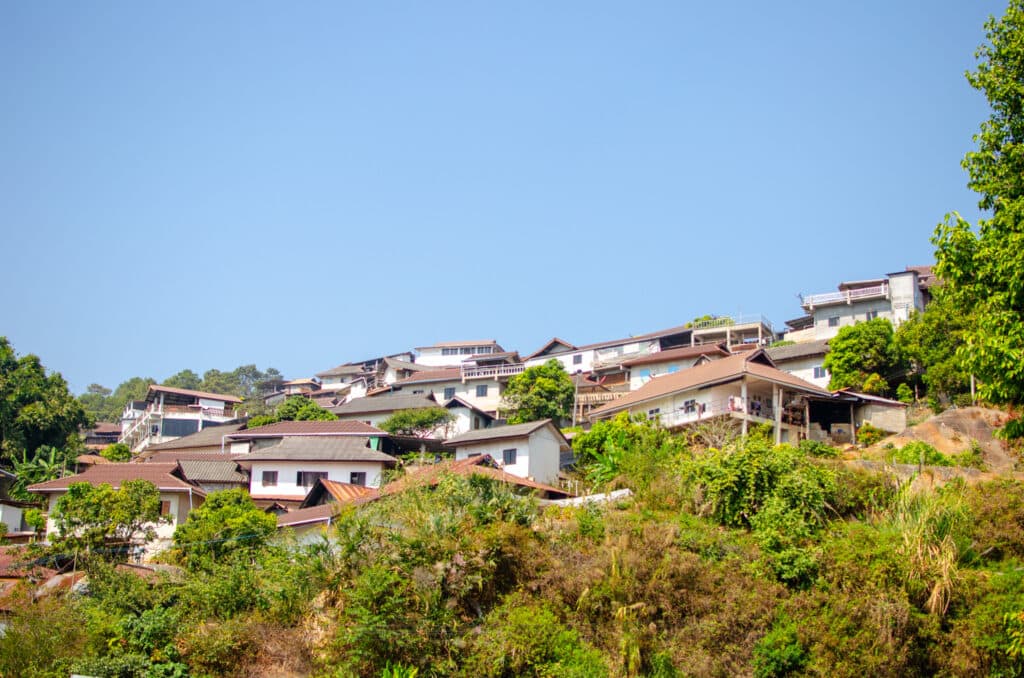
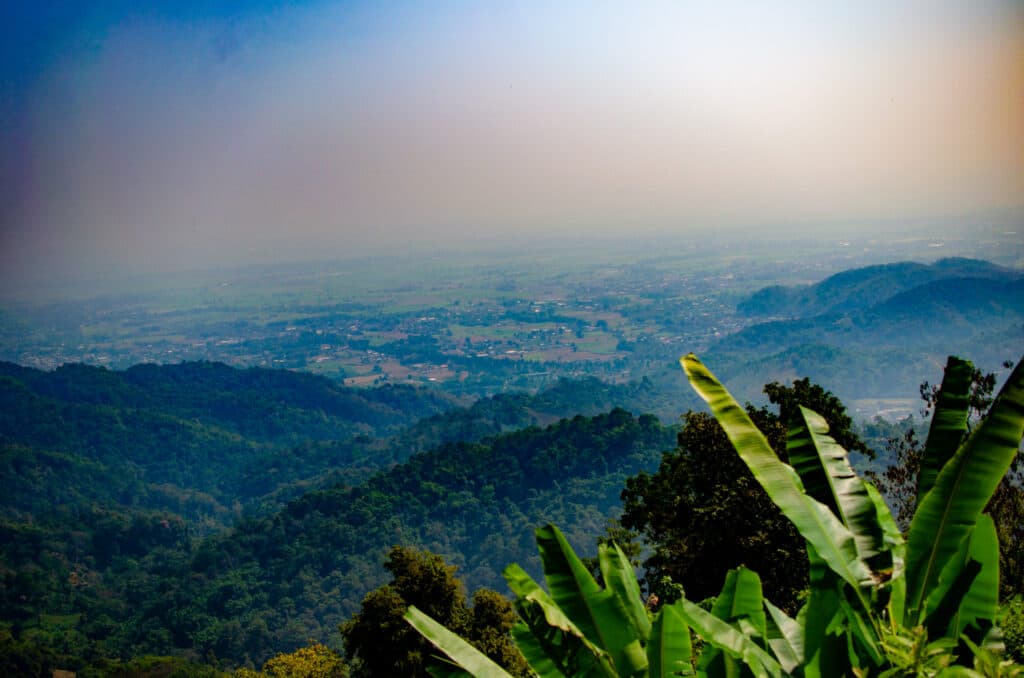
After the tea plantation, I decided to head into the mountains. On the way to Doi Tung, which is one of the highest points in the area, I stumbled upon a nice, quiet view point. There were a number of shops and a toilet at the parking lot, where I stopped. One of the places sold noodle soups, which I love. I never say no to a good bowl of this fragrant dish, so I ordered it and sat at a table with a nice view over the hills. Sadly, it was the start of the burning season and quite a lot of the panorama was covered with smoke. I think it would be great to see it in December or January, where the hills are green and the air is clean.
On the other side of the street, there is a small village. As far as I know they offer accommodation. I would suggest to look for something there in the winter on Agoda. I’m sure you will be able to find cheap lodging for a good price.
Tip: I drove a scooter around the area and it’s very pretty, but please be careful and take care on the road. Remember to have the right driving licence. If you’re in Thailand longer, you can do a course and have the local driving licence.
Doi Tun Royal Villa and the botanical garden
A little farther north, in the Doi Tung Mountains, stands the former summer residence of the Royal Family. The house itself was built on the model of Swiss mountain huts. It is a beautiful wooden building.
Some of the rooms look exactly as they did during the years when the royals stayed there. In the showcases you will find items used by the Royal Family. You’ll also learn a bit about what the current King’s beloved grandmother liked to do in her spare time and what she did and achieved during her lifetime.
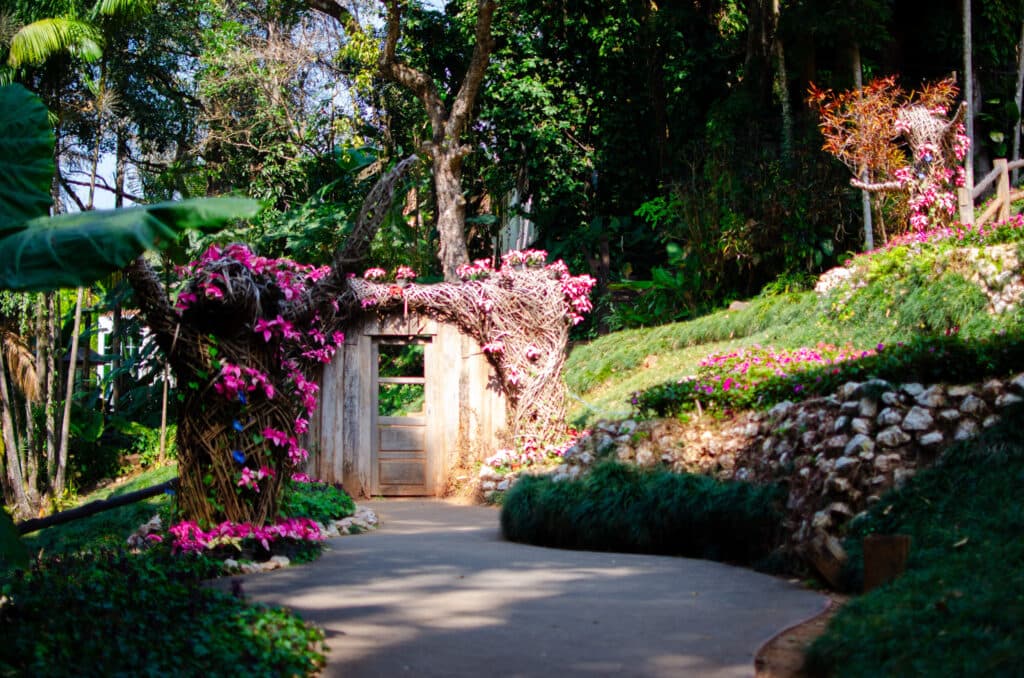
At the foot of the house spreads a sizable botanical garden. Many species of trees, shrubs and flowers grow here. A lot of effort is put into maintaining this place, and it shows. This garden is even more beautiful than the one you’ll find near Chiang Mai.
If you don’t like crowds – good news! There are almost no tourists here. The villa was practically empty when I was there. The gardens were enjoyed by a few locals, but it seemed to me that this was a place that tourists didn’t reach. So, if you’re looking for something a bit off the beaten path, this is a great choice.
Phu Chi Fa
I don’t have that many photos from this place and I really need to go back to see it. I went there over 10 years ago, when I first came to Thailand. Back then I did blogging for fun and I didn’t even have the right camera. My photos from there aren’t great, so I won’t be sharing them here.
Phu Chi Fa is a mountain near Chiang Rai, on the border with Laos. You drive there on very steep roads, so it’s a good idea to have either a large motorcycle or 4-wheel drive in your car. I made it there in a passenger car, but it was really tough.
I stayed one night in a nearby village and in the morning I went for a sunrise to the peak. The view over the hills and the border with Laos is mesmerising in the morning sun. I still remember the magic of it – the atmosphere that was filled with anticipation, waiting for the day to start and the red and orange light that covered the area. I really need to do it again!
Your plan of things to see and do in Chiang Rai
You can visit Chiang Rai in one day. During this time you will definitely see the major attractions in the city. You’ll need to leave yourself an extra day for the mountains.
Travelers who don’t have a lot of time are free to arrange a day trip from Chiang Mai. In this case, first go to the White Temple, then have lunch in the city, and then go to the Blue Temple, Wat Huay Pla Kang, and finally leave yourself the Black House.
If you have more time and are staying overnight in Chiang Rai, then head to the mountains on the second day, to Dui Tung. For those with large cars or motorcycles, I recommend going to Phu Chi Fa and staying there overnight for sunrise.
Moving with something smaller? Drive to Doi Tung and see the botanical gardens, the villa and just take in the views.
Is it worth visiting Chiang Rai?
Did you know that Chiang Rai was founded earlier and is older than Chiang Mai? It was the first capital of the Lanna Kingdom in the 13th century. It was here that the culture of the northern region, of which the Thais here are so proud, developed.
Chiang Rai is not large. Only 200,000 people live here – far fewer than in the regional capital, Chiang Mai. Because it is even farther north, many travelers choose to forgo a visit. Sometimes, hounded by limited time, tourists opt for quick tours of the most important temples. I understand this, and I know that it’s not easy to see everything during the vacations. However, it is worth a visit not only because it is an important city in Thai history, but also because of the many interesting temples and sites to see.
Not far from Chiang Rai there are also high mountains, which, especially during winter, create a specific microclimate. You can even freeze here! These mountains offer beautiful views, and hide many attractions – gardens, villages, waterfalls, tea and coffee plantations. All this is about a 40-minute drive from the city.
Chiang Rai itself is an extremely pleasant city, much less crowded, quieter and gentler than Bangkok and Chiang Mai. Here you can really feel the spirit of northern Thailand.
So, to answer the question in the title of this paragraph – is it worth visiting Chiang Rai, Thailand? Of course it is. I highly recommend spending at least one day there.
When to visit?
The best time to visit the north is always December-mid-February. From mid-February to mid-April there is smog.
From mid-April to June, expect very high temperatures. In my opinion, you can go to Chiang Rai then, but sightseeing will be hampered by the heat. In addition, everything is very dry then and the landscape is brown, so for sure the views in the mountains will not be so beautiful.
June-November is the rainy season. It is often difficult to predict what the weather will be like. In the north, it often pours in the evenings, but you can also expect to see precipitation during the day. The skies are also often overcast and just plain white.
If you want to visit the area, it’s definitely worth going there between December and March. It certainly won’t be as beautiful in other months.
How to get there?
The easiest way to get to Chiang Rai is from Chiang Mai. There are about 200 kilometers between the cities.
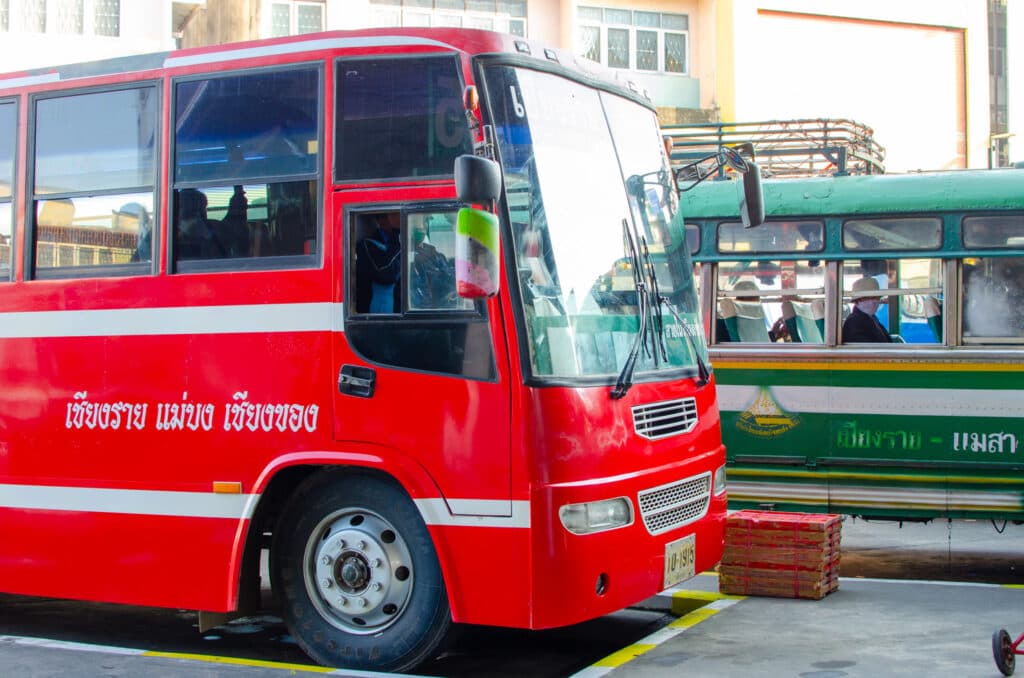
There are buses that run from Chiang Mai. The trip takes about 2-2.5 hours. The buses are large and comfortable. There is a toilet on board, you also get a snack and water. The bus stops once along the route for about 10 minutes. Buy your ticket here or at the bus station in Chiang Mai.
Chiang Rai has its own airport. AirAsia offers flights between Chiang Mai and Chiang Rai, among others. Costs vary, depending on the time of year, but you can find flights for as little as 20 USD.
I think it is possible to get to Chiang Rai and return in one day if you want to go there by bus or plane. However, this requires planning and having a contingency plan, such as if you are late for transportation.
Those wanting more flexibility can rent a car in Chiang Mai or Chiang Rai. To drive a car in Thailand you should have a valid driver’s license and an international license. By car, you will definitely find it easier to go and return in one day.
Find out more about transport in Thailand.
Whether you’re renting a car or scooter, make sure you have travel insurance. I use SafetyWing which covers accidents, medical emergencies, and even theft. Plans start at $45/month.
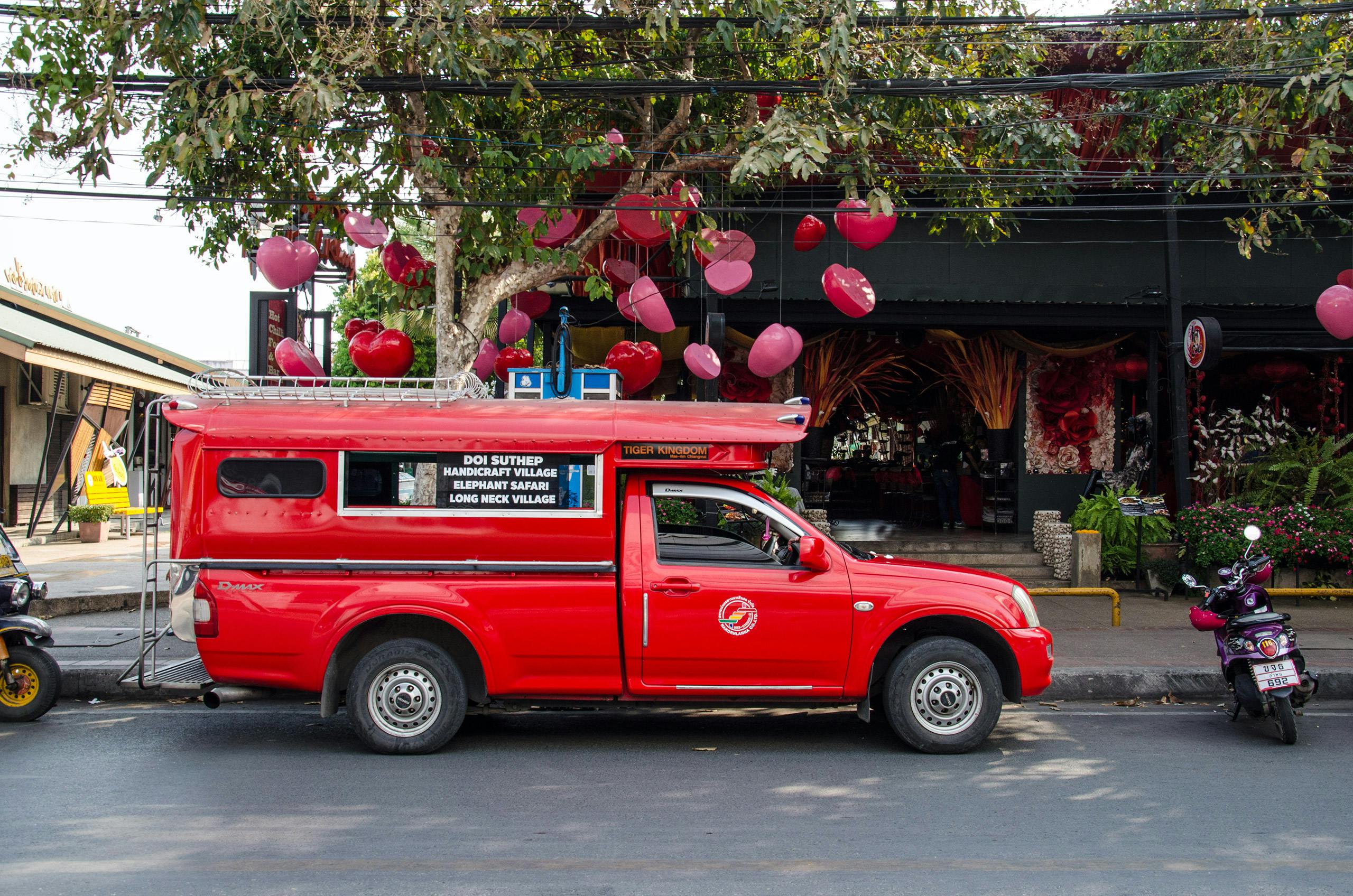
There are also day trips to Chiang Rai from Chiang Mai. You leave at 8am and return late in the evening. The itinerary always includes a tour of the main attractions. Sometimes others are added, such as the village of Long Neck. I recommend asking your driver to take you to Phayao for sunset.
Browse all Chiang Rai tours on TakeMeTour – my trusted partner – including White Temple tours, Blue Temple visits, and full-day excursions from Chiang Mai.
Accommodation
There are quite a few hotels to choose from in Chiang Rai. I stayed at a very popular place – The Mira Hotel. The location is great. You don’t even have to drive anywhere. You have a 5-minute walk to the main street. The rooms are large and very clean. The staff also got us a scooter at no extra charge. Unfortunately, there were downsides – the air conditioning, although new, was very noisy at night and often turned off. Until midnight we could hear the bass from a nearby bar. The bed was not the most comfortable. I would give Mira 4 stars out of 5.
Find more accommodation on Booking.com.
What and where to eat?
I made myself a list of restaurants before the trip and almost every one was a slight disappointment. In some places, the food was not typically Northern Thai and was very expensive. In other restaurants, it just wasn’t tasty. The only place I can wholeheartedly recommend is Simply Northern Thai Food, where you will find very tasty northern cuisine. Order a couple – remember that in the north people share food. Top it off with sticky rice, which you eat with your fingers, forming balls and scooping other dishes with them. Enjoy!
I left Chiang Rai quite early in the morning. I sat at the bus station, decorated with beautiful murals depicting national minorities, and knew I had to come back here. Due to limited transportation, I didn’t go further into the mountains, and it’s certainly something I enjoy doing and would like to see more of the local area.
Planning Your Thailand Trip?
You have two options:
Option 1: DIY with my Ready-Made Guide (40 PLN/€9)
Get my complete 2-week Thailand itinerary covering Bangkok, Chiang Mai, and the islands. Includes day-by-day plans, restaurant recommendations, and insider tips. Buy Ready-Made Guide
Option 2: Custom Travel Plan (300-600 PLN/€70-140) I’ll create a personalized itinerary based on: – Your travel dates and pace – Your budget and interests – Special requests (accessibility, dietary needs, etc) Includes video consultation + detailed PDF plan. Request Custom Plan →
Frequently Asked Questions About Chiang Rai
Absolutely! Chiang Rai has unique temples like the White Temple and Blue Temple that you can’t see anywhere else in Thailand, plus beautiful mountain scenery.
1 day is enough for the main temples in the city. Add a second day if you want to explore the mountains, tea plantations, and Doi Tung.
Yes! It’s 2-2.5 hours by bus. You can visit the White Temple, Blue Temple, and Black House in one day and return to Chiang Mai in the evening.
December to mid-February is ideal. Avoid mid-February to April due to smog season and extreme heat.
By bus (2.5 hours, ~200 THB), flight (30 minutes, from 600 THB), or rent a car for more flexibility.
🌴 Complete Thailand Travel Plan
4 Routes in One Place – 2 Weeks
Can’t decide between Krabi, Phuket, Koh Tao or eastern islands? Now you don’t have to choose – you get all 4 options with complete itineraries!
✨ Bangkok → Chiang Mai + 4 beach options
✨ 206 pages | Day-by-day itinerary | Hotels | Restaurants | Transport | Budgets
💡 Or choose a specific route:
On your trip to the north of Thailand, don’t skip Chiang Rai. Come here at least for a day to see the temples and unusual buildings that are only found in this city in Thailand.