Live abroad
Cost of living in Thailand: Can you afford it?
Destinations

Joanna Horanin
Current condition

Weather in Thailand
Light rain shower
Temperature
Feels like 29.3℃ 😎
UV index
Low
Air quality index
Moderate
Last updated at 10/09/2026, 18:15
Hi, I'm Joanna, the author of The Blond Travels. In the worlds of Thailand and Portugal, I feel like a fish in water - and it's no coincidence! I've been exploring Thailand for over a decade, and I've settled in Portugal for 6 years now. My mission is to support Dreamers - just like you - in discovering these fascinating countries and helping those in love with them find their own place on Earth, preferably for good! Let's uncover these unique corners of the world together.
- Costs of living and location
- How much is food in Thailand?
- The cost of transportation in Thailand
- Insurance for expats – Cost
- How much does it cost to get a visa in Thailand?
- How much do I spend? How much did I spent?
- Cost of living in Thailand – FAQs
Thailand is not only popular because of its weather, food and smiling people, but also because of relatively low prices. You can live here comfortably on around $800 a month. It all depends on which part of the country you want to live in and what kind of lifestyle you prefer.
Expats, who have been living in the Land of Smiles for some time, spend a little more than those who take their first steps here. I think it’s because of the fact that after a while Thai food can be a bit boring and western food costs twice as much. Expats also like to create a bubble in which they live and enjoy western entertainment. They like going to the cinema, to a gym, or to good bars and restaurants. However, it still costs them less than it would in Europe.
I lived in Thailand for a couple of years and every year I go back to spend one month working remotely and one month travelling through different places in the country. My friends who live there permanently also inform me about changing costs of living. My experience with living in Thailand is really broad and I have good comparison between different lifestyles. In this article I have included everything you need to know about costs of living in Thailand. I hope it will help you with your move to the Land of Smiles.
Last update – September 2026
Quick answer: A single person can live comfortably in Thailand for $700–1,800/month depending on lifestyle and location. Chiang Mai runs cheapest — roughly $700–900/month living the way locals do, or $1,300–1,800/month for a comfortable, nomad-standard setup. Bangkok sits higher, around $1,200–2,500/month, with better infrastructure and more going on in exchange for the cost. The islands (Phuket, Koh Phangan, Koh Samui) land somewhere in between depending on how close to the beach you want to be. Rent is what moves the number most — everything else (food, transport, entertainment) stays fairly stable across regions.
Costs of living and location
| Region | Lean / local budget | Comfortable / nomad-standard |
|---|---|---|
| Chiang Mai & the North | ~$700–900/month | ~$1,300–1,800/month |
| Bangkok | ~$1,200/month | ~$1,800–2,500/month |
| Phuket | ~$900–1,200/month (inland — Chalong, Rawai) | ~$1,600–2,000+/month (near-beach, high season) |
| Koh Phangan & Koh Tao | ~$700–1,000/month | ~$1,200–1,500/month |
Costs of living vary depending on localization. At the moment the north of Thailand is the cheapest. In Chiang Mai an average cost of living is around $700-900. Some spend more, but if you like saving money and are not interested in dining in Sizzler, or drinking beer every weekend, then you can live on less than $1,000.
Bangkok is slightly more expensive. Expats here like to indulge in shopping and dining out. The capital of Thailand offers huge shopping malls, exclusive restaurants, galleries and theatres. There are plenty of places to spend your money at. I think you need to spend at least $1,2000 to have a good lifestyle. If you are frugal then of course it’s possible to spend less. Don’t go out every weekend, eat only in local bars and don’t spend on any unnecessary things.
In the south life is a little calmer and more relaxing. There is not much to do here. However, before you choose a place to live in Thailand, check the prices first. Phuket seems to be the most expensive out of all the islands and it’s also the most popular place to live for western expats. Koh Phangan is cheaper, but also a little calmer and doesn’t offer as much as Phuket.
The food is more expensive in the islands. If you don’t have a scooter and you live by a beach then you might be forced to eat at resorts, where a plate of fried rice costs from 60 to 150 Baht. In this case, it’s better to look for accommodation in bigger towns, where you can shop at local markets and buy cheap street food. Rental prices are also quite low here. For a house on Koh Phangan or Koh Tao you will pay around 12,000 Baht – as much as for an apartment in Chiang Mai. On some of the islands, you can live comfortably on 20,000 – 30,000 Baht a month, if you don’t splurge too much.
Accommodation prices (for 2026)
Bangkok
- 2 bedrooms, 2 bathrooms, 65 square meters, centre – 45,000 – 55,000 Baht
- 1 bedroom, 1 bathroom, 50 square meters, centre – 35,000 – 45,000 Baht
- 1 bedroom, 1 bathroom, 45 square meters, outside of the city centre – 15,000 – 22,000 Baht
- Studio, 30 square meters, centre – 18,000 – 25,000 Baht
- Studio, 30 square meters, outside of the city centre – 10,000 – 14,000 Baht
- House, 4 bedrooms, 2 bathrooms, outside of the city centre – 55,000 – 90,000 Baht
Chiang Mai
- 2 bedrooms, 2 bathrooms, 65 square metres, centre – 28,000 – 35,000 Baht
- 2 bedrooms, 2 bathrooms, 65 square meters, outside of the city centre – 20,000 – 25,000 Baht
- 1 bedroom, 1 bathroom, 50 square meters, centre – 17,000 – 22,000 Baht
- 1 bedroom, 1 bathroom, 50 square meters, outside of the city centre – 13,000 – 17,000 Baht
- Studio, 30 square meters, centre – 12,000 – 16,000 Baht
- Studio, 30 square meters, outside of the city centre – 9,000 – 12,500 Baht
- House, 4 bedrooms, 2 bathrooms, outside of the city centre – 18,000 – 30,000 Baht
Phuket
- 2 bedrooms, 2 bathrooms, 65 square meters, inland (Chalong, Rawai), low season – 25,000 – 35,000 Baht
- 2 bedrooms, 2 bathrooms, 65 square meters, near-beach, high season – 45,000 – 70,000+ Baht
- Studio, 30 square meters, inland, low season – 15,000 – 20,000 Baht
- Studio, 30 square meters, near-beach, high season – 25,000 – 35,000+ Baht
How much is food in Thailand?
Thailand is the paradise for food lovers. Everyone will find something for themselves. Street food is everywhere and you can enjoy it for a really low price. However, dishes are usually fried or cooked in oil, so it’s not an ideal solution for those wanting to look after their waste lines.
Thai people don’t overeat, but they like to snack in-between meals. That’s why you need to get used to small portions. Fortunately, snacks that are sold everywhere will get you through to the next meal.
Cooking in Thailand is not worth it. If you do your own shopping you will soon find out that it’s much more expensive than eating out. That’s why most of the apartments in Thailand don’t have kitchens.
Alcohol in Thailand is pretty expensive. If you like to go out on weekends then a whole night party might cost you a lot. One bottle of beer costs 100 Baht and that’s the cheapest price. In clubs in Bangkok you will pay more.
Stronger alcohol is available, but foreign brands are expensive and can discourage some of the teachers from spending money on them.
If you don’t want to spend so much, then go for a local brand. A bottle of Sangsom in 7-11 costs 250 Baht. It’s not the best alcohol, but you will save some money.
Shakes are smoothies are very popular in Thailand. One large cup of this type of drink costs 30-50 Baht.
Don’t forget to drink water! In 7-11 you will buy 5 liters of water for 30 Baht. In some buildings, you can purchase it from the landlord. For a crate, you will pay 100 Baht. You can also use a water dispenser and fill up your bottle for 5 Baht. It’s good to remember that in some local bars drinking water is free.
In Thailand there are a lot of vegetarian bars and vegetarian dishes. It’s not a problem to find a bar serving cheap buffet. You can fill up your plate with some delicious things for only 20-30 Baht.
Many foreigners like to go to more expensive places, where MSG is not added and where dishes are more expensive – 70-120 Baht.
There is no lack of western food in Thailand. However, it’s not always good and you might take some time to find something decent and at a good price. Thai people don’t really know how to cook western food and except Italian and American restaurants there is not much of a choice. Comparing to Thai food western dishes are very expensive. For a pizza or a burger, you will pay around 150-250 Baht. A breakfast with a fried egg and a sausage costs 100 Baht.
Example of prices:
- Pad Thai at a street cart – from 60 THB (local price) – at a more touristy place e.g. night market on Koh Samui it can cost 100 THB and more
- Pad Thai in a restaurant – 100 THB and up
- Curry on one of the islands – 100 THB and up
- Pizza or any other foreign dish – over 200 THB
- Ready to eat fruit – 30-50 THB
- Fruit at a market – 100 THB per kilo
The cost of transportation in Thailand
In Bangkok there are many options of transportation. So-calleded BTS, an overground train, is very fast and modern. Its lines don’t go all over the city and to get to some places you need to take a taxi, or a bus. BTS has something that is very valuable in Thailand – air conditioning, so taking this type of transport is quite pleasant. An average cost of a ticket is 15-52 Baht.
Busses in Bangkok are not very reliable and taking one might turn out to be a huge task. If it’s your first time in Bangkok then it will be very easy for you to get lost. One ticket costs around 7-8 Baht.
Bangkok is the only city in the world using boats as public transportation to such an extent. Stops are very easy to find and you can get almost anywhere. A big disadvantage is lack of air conditioning and overcrowding during rush hours. A ticket costs 15 Baht.
Another transportation option is motorbike taxis. For only 20 Baht you can whizz through the streets at the back of a scooter. Such taxi will take you everywhere and at any time.
Normal taxis have a bad reputation because of scams and not being very helpful to foreigners. Before you get in, make sure that the driver agrees to put the meter on. Rides start from 40-50 Baht. Instead, take a GRAB – this works like Uber. They are very reliable and the prices are fair.
Tuk tuks are the most expensive and it’s an option for tourists. Expats and locals don’t usually use them.
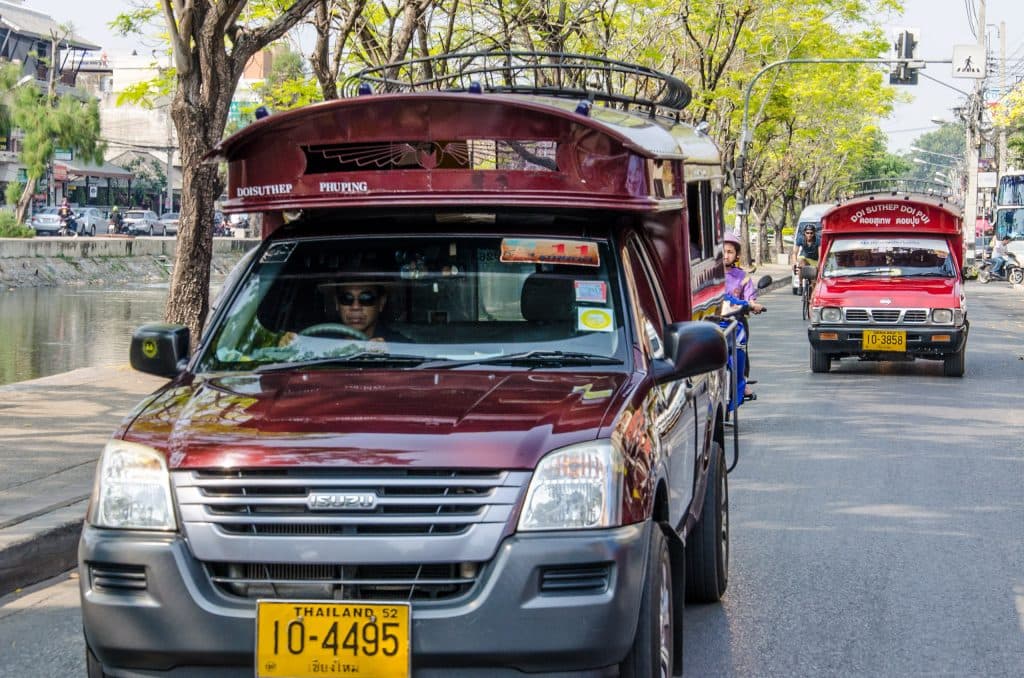
Transportation in Chiang Mai is a bit less developed. The most popular option are songthaews, big pick up trucks, which cost 30 Baht for one ride.
Except that you can use tuk-tuks, which are a bit cheaper here. One ride costs about 100 Baht.
The south has quite a few transportation options. On some islands, you will find motorbike taxis. The prices vary depending on how you want to get somewhere. The most popular are songtheaws and one ride costs 50-70 Baht.
Traffic in Thailand might be a bit scary at first. However, I’m a huge fan of having my own transport, which gives me a lot of freedom. I ride a scooter and think that it’s a great way of seeing the city and its surroundings.
Many expats choose to have their own transport. Scooters are the most popular in Thailand. Buying a scooter is not very hard and a few year old ride costs 20,000 – 25,000 Baht. Renting depends on a model and engine, but an estimate is 150-250 Baht per day.
People who have their own business in Thailand, or who prefer to trave safer choose cars. Older models are available at the same prices as scooters. Renting a car is not that expensive and costs 1,000 – 2,000 Baht per day.
Insurance for expats – Cost
One of the most important advice I give everywhere is: get a good medical insurance. The cost of healthcare in Thailand is low, but if you get sick, or have an accident, the bill for your treatment might be very high. It’s better to invest some money and not to worry too much.
Medical insurance is one option. It’s probably the best if you want to stay in Thailand for a long period of time. They will cover you for any emergencies, outpatient and inpatient services. I recommend Luma – which works very well in Thailand and in Asian countries or Cigna, which is more international. Both have great policies and offer English speaking customer service.
🛡️ Health Insurance in Thailand, Done Properly
Real cover for people who actually live here — not a two-week travel policy
LUMA works with a network of 450+ hospitals across Thailand and covers what actually matters if something goes wrong. I’ve worked with them for years and recommend them to every expat who asks.
✨ What’s actually covered
Free, no-obligation — response within 24 hours on business days
Get your quote →This is an affiliate link — I earn a small commission at no extra cost to you.
*Renewal terms vary by plan; ask LUMA which applies to yours.
These types of insurance is quite expensive, but if you want to save some money, you can apply with one of the Thai banks. They charge around 20,000 – 25,000 Baht per year.
You can also go for a cheaper option and get a travel insurance. Just be prepared that you will need to go home for any longer treatments. For digital nomads, I always recommend SafetyWing, which is ideal for people travelling for a long period of time.
SafetyWing — best if you travel often
SafetyWing’s Complete plan covers outpatient care, screening, medication and maternity — plus lost luggage, cancelled flights and stolen electronics, wherever you are. Claims are processed in as little as 48 hours.
Get a SafetyWing quoteHow much does it cost to get a visa in Thailand?
Visa will be another cost if you want to live in Thailand. Sometimes it’s not very high, but for some of you it will cost and arm and a leg.
The cheapest visa is a tourist visa, which costs around $50. However, this will last you for 3 months and you’ll have to figure out a way to get another one. Many digital nomads in Thailand nowadays have DTV visa – it costs around $200 and lasts you 5 years.
There are non-immigrant visas for people who work in the Kingdom and the costs depends on the type of your visa. It can cost anything from $200 to $500.
The most expensive is the Elite Visa, which costs over $20,000 and can last you for 10 years.
Read more here about non-immigrant visas.
How much do I spend? How much did I spent?
I lived in Chiang Mai between 2013 and 2016. As a teacher, I spent around 20,000 THB per month. This is how much I earned back then. I didn’t safe and I really enjoyed myself. Then, I was a digital nomad from 2016 until 2018. According to my calculations, I spent 20,000 – 30,000 Baht per month, so around 700-800 Euro. That was minimum. This included weekend trips outside of town, dinners in the best restaurants in Chiang Mai, cinema, and massages.
Right now, I travel to Thailand more as a digital nomad/tourist. I spend one month in Chiang Mai. I pay around 700 Euros for rent – this is divided between me and my husband. We spend around 1,000 Euros each for the rest – this includes staying in Chiang Mai and travelling around Thailand (with flights and accommodation). It might be more sometimes and it all depends on what we do and where we go.
Cost of living in Thailand – FAQs
Realistically, $700–2,500/month depending on where and how you live. Chiang Mai is the cheapest option at $700–900/month for a lean, local-style setup, or $1,300–1,800/month living more comfortably. Bangkok runs $1,200–2,500/month, and Phuket swings the most — inland living can be $900–1,200/month, while beachfront in high season can push past $2,000.
For most people coming from the UK, US, or Western Europe, yes — often significantly. Rent alone can be a third to a half of what you’d pay at home for comparable space, and everyday costs like food, transport, and healthcare are generally lower too. The exception is imported goods and Western-brand products, which can cost the same or more than at home.
Rent, by far — it’s the number that moves your total budget more than anything else. Where you fall on the “local vs. nomad-bubble” spectrum (a basic outside-centre studio vs. a Western-friendly condo near coworking spaces) can roughly double your monthly cost before you’ve spent a baht on anything else.
Chiang Mai is generally the cheapest of the main hubs, followed by Koh Phangan and Koh Tao for a simpler island lifestyle. Bangkok costs more but buys you better infrastructure, transit, and healthcare access. Phuket sits in between — genuinely affordable if you live inland, considerably pricier right on the beach, especially in high season.
Yes, especially in tourist-heavy areas. Phuket rents can rise sharply during high season (roughly November–April), and Chiang Mai rentals sometimes dip during burning season (February–April) as some foreigners temporarily leave for cleaner air. Bangkok and inland areas are comparatively stable year-round.
Yes, particularly outside the most touristy pockets of Chiang Mai, Phuket, or the islands. Sticking to local markets and street food over Western restaurants, renting outside the centre, and using motorbike rental or public transport instead of taxis are the main levers — they’re what separate the $700/month version of a city from the $1,500+ version.
This post includes affiliate links.