
Travel
Chiang Khan: What Happens When You Stay Longer Than a Weekend
Destinations

Joanna Horanin
Current condition

Weather in Northern Thailand
Light rain shower
Temperature
Feels like 26.9℃ 😎
UV index
Low
Air quality index
Good
Last updated at 10/09/2026, 20:30
Hi, I'm Joanna, the author of The Blond Travels. In the worlds of Thailand and Portugal, I feel like a fish in water - and it's no coincidence! I've been exploring Thailand for over a decade, and I've settled in Portugal for 6 years now. My mission is to support Dreamers - just like you - in discovering these fascinating countries and helping those in love with them find their own place on Earth, preferably for good! Let's uncover these unique corners of the world together.
- Qiuck facts about Chiang Khan
- The town everyone’s talking about
- Monk offering ceremony
- Through Isaan by scooter
- The morning blessings at the neighbours’ house
- 150th city anniversary and a beautiful parade
- Chiang Khan – Practical Information for visitors
- Chiang Khan – FAQs
I spent three weeks in Thailand. It was June, and it had been a long time since I’d last been there during the rainy season. I’ve been travelling around the country for 14 years, but this was my first visit to the Isaan region, in the north-eastern corner of the country. After the wonderful and chaotic Phi Tha Khon festival, I wanted to relax a bit, but also see something new. I eventually chose Chiang Khan, known as the pearl of Isaan and its hidden treasure. At the time, I didn’t yet know that Chiang Khan would become one of my favourite places in Thailand, where I would also experience some magical moments.
I expected it to be a quite stay. Many sources pictured Chiang Khan as a lovely, northern town with a laid-back atmosphere. I was ready for some good sleep, relaxing and maybe trips on a motorbike outside of the town. Well, Chiang Khan surprised me in this regard, too. My visit was far from relaxing.
This article is for you if you’re looking for unusual, off-the-beaten-track and remote places in Thailand. Here you’ll find peace and quiet, a town untouched by mass tourism, where local life still goes on as normal and where you can relax. Chiang Khan is something completely different from the places you may already be familiar with. Here, you’ll fall in love with Thailand and, perhaps, just like me, experience some magical moments. I invite you to read a few of my stories from my stay, but also to find out what to do and see in Chiang Khan.
Qiuck facts about Chiang Khan
Chiang Khan at a Glance
| Where | Loei province, Isaan region, on the Mekong River (Laos border) |
| How many days to plan | 2-3 days minimum, though I stayed 4 and it was worth every one |
| How to get there | Overnight bus from Bangkok, or fly into Loei (LOE) and transfer, or travel via Chiang Mai/Dan Sai |
| Best time to visit | October to March, when mornings by the river are cooler |
| Getting around | Walk the old town, rent a scooter for the viewpoints further out |
| Don’t miss | The old town and Chai Khong Road, the night market, the Mekong viewpoints |
| Chiang Khan vs Chiang Mai | Not the same place. Chiang Mai is a big northern city; Chiang Khan is a small riverside town in Isaan – quieter and far less touristy |
| The vibe | Slow pace, local life, few foreign tourists |
The town everyone’s talking about
I travelled to Chiang Khan by taxi from Dansai, where I’d previously attended the Phi Tha Khon festival. As I drove along the winding streets towards my hotel, I already knew I was going to like it here. I had seen it on social media, where it was shown as the undiscovered pearl of Thailand, but only when I got there, I truly believed this statement.
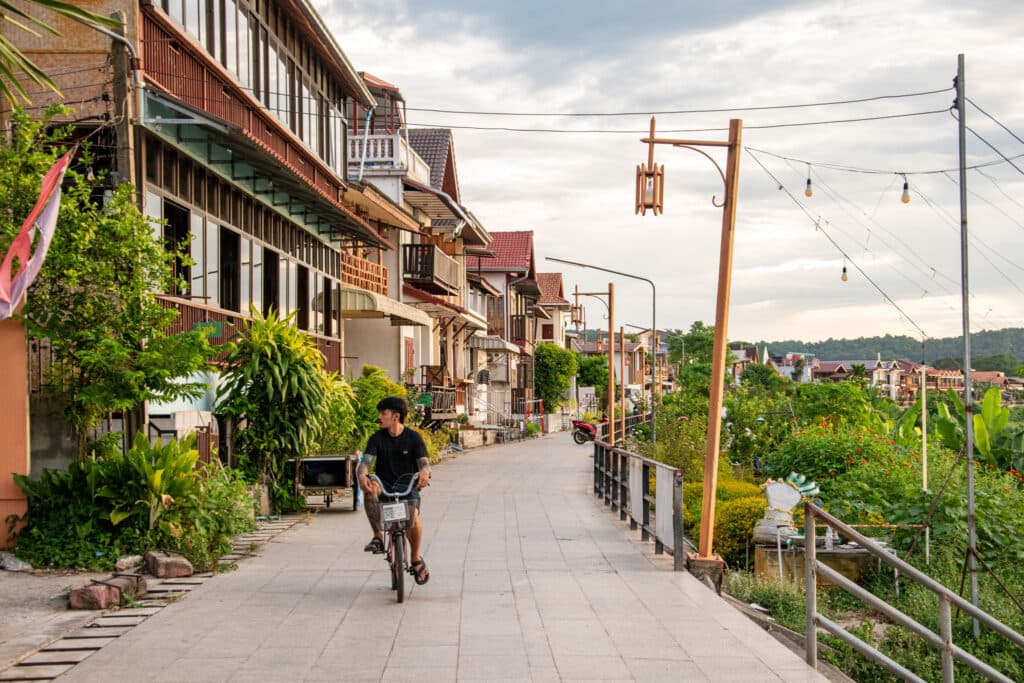
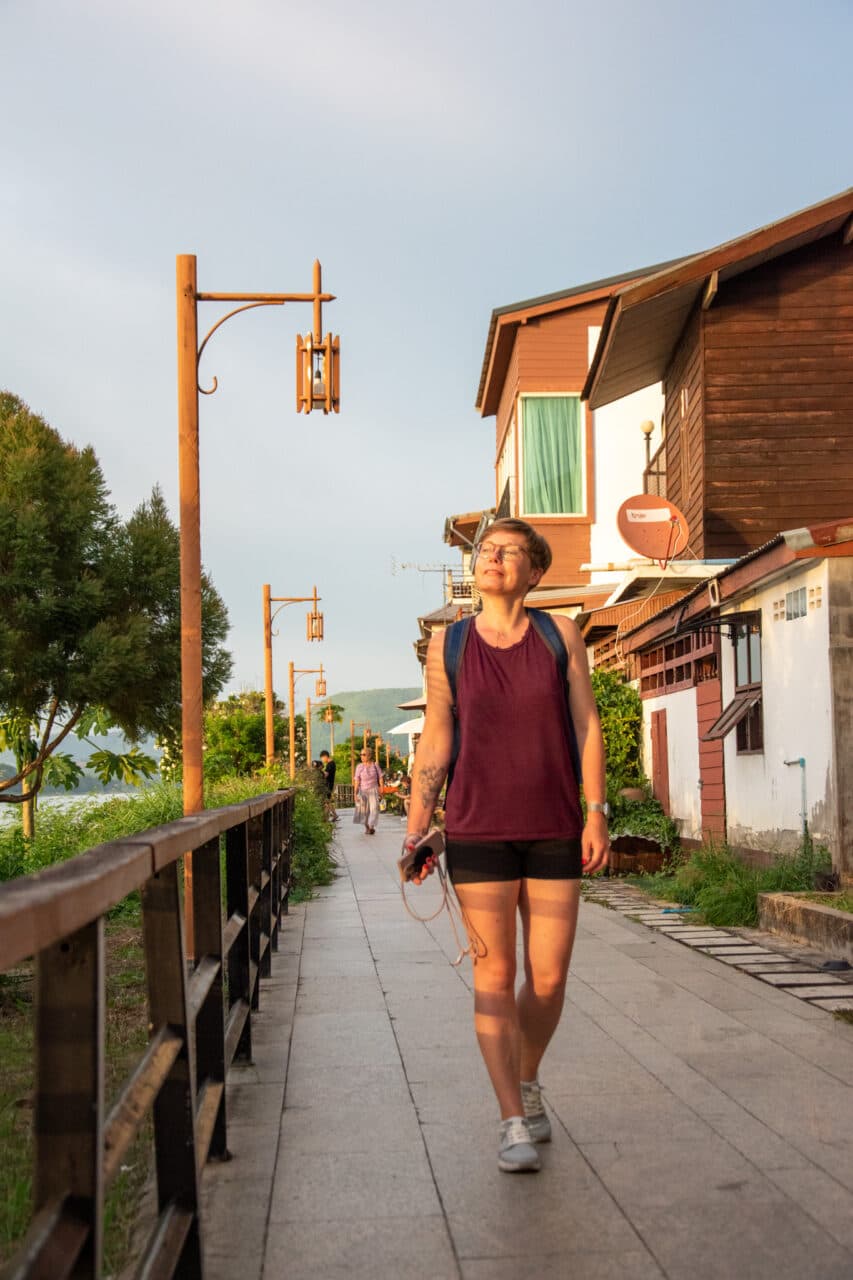
At sunset, I went for a stroll. The main attraction in Chiang Khan is the promenade, which runs behind the main road and offers views of the river and the opposite bank. Along the promenade, bars and restaurants were just getting ready for the evening crowds. I strolled along it, stopping at the viewing points to admire the beautiful panorama and marvelling at the golden light falling on the street.
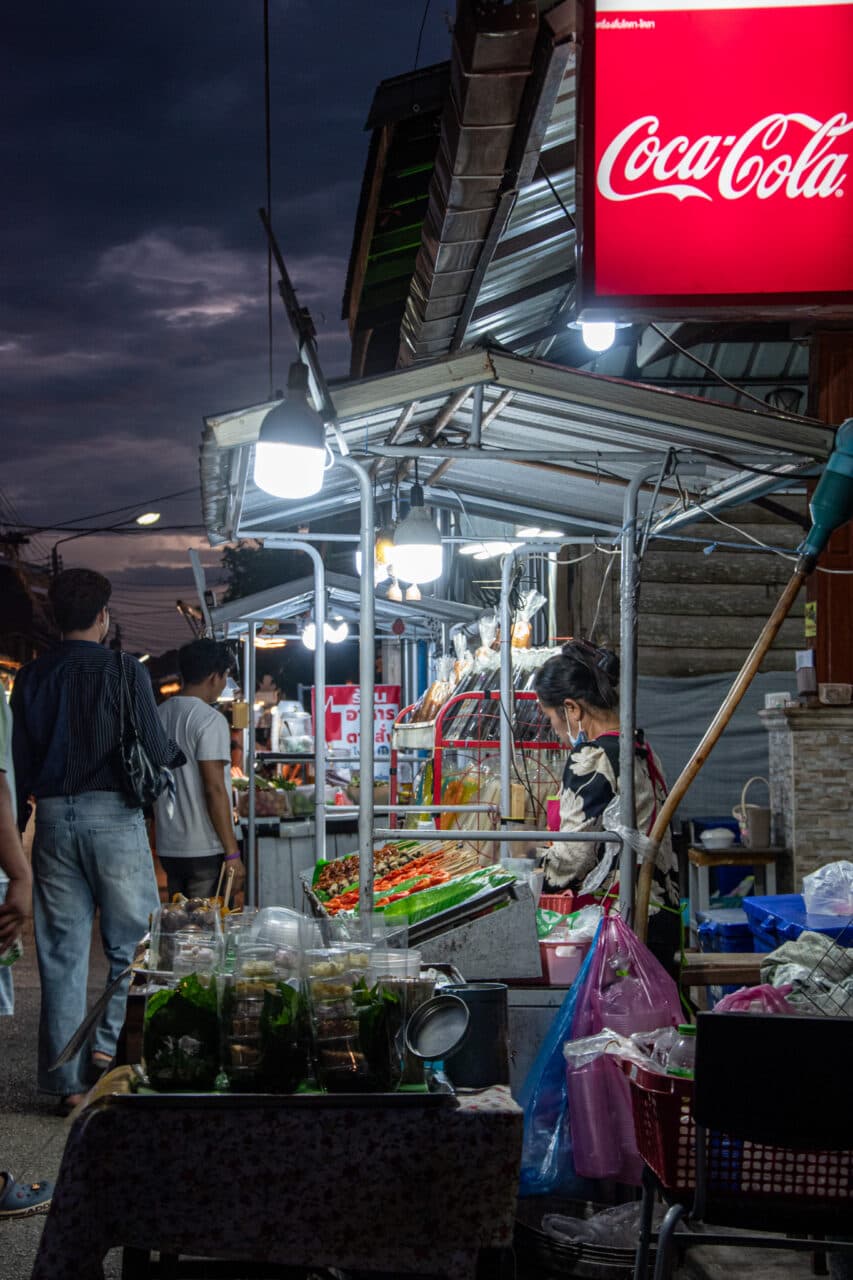
That’s how I ended up at the night market – or rather, its main section. Around 6–7 pm, the stalls start setting up, the vendors bring out their wares, and all sorts of smells waft through the air. The market in Chiang Khan still has the atmosphere of the real Thailand. In places like this, where there are fewer foreign tourists, the markets sell only local food, which is a far cry from pad thai or tom yum. In Chiang Khan, apart from what I’d already seen – such as sausages, sweetcorn with condensed milk, or even sushi and pizza (always served with mayonnaise) – I was treated to grilled prawns in their shells and small crabs, also served whole in their shells. Skewered and warmed through before serving, they’re a real delicacy in this region.
Monk offering ceremony
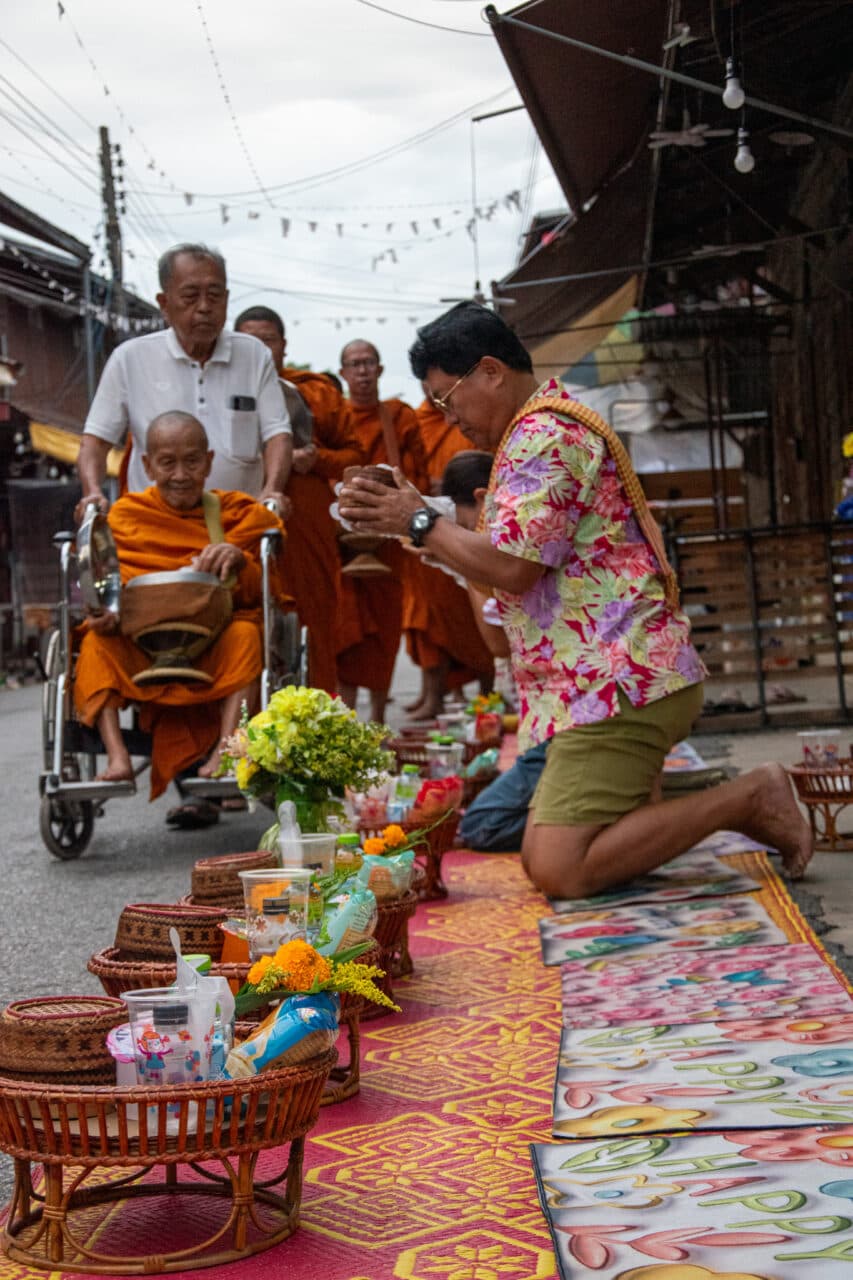
I began the next day by photographing the morning offering of alms to the monks. This is a tradition observed throughout Thailand. At sunrise, barefoot monks walk through the streets with their alms bowls, collecting offerings from the faithful. The locals step out in front of their houses, lay out their offerings and wait for the monks, who bless the donors before taking the food. In Sukhothai, I had the chance to take part in such a ceremony myself. Here, I was merely an observer. I’ve seen similar ceremonies many times before. It was wonderful in Chiang Khan because I was the only tourist; there were no crowds, and the locals were really very polite and friendly.
Through Isaan by scooter
On the second day, I hired a scooter from a nearby rental shop. My aim was to ride around the area, take in some of the natural scenery, and perhaps see a waterfall or two. I didn’t know, nor did I expect, that the weather would make all that rather difficult.
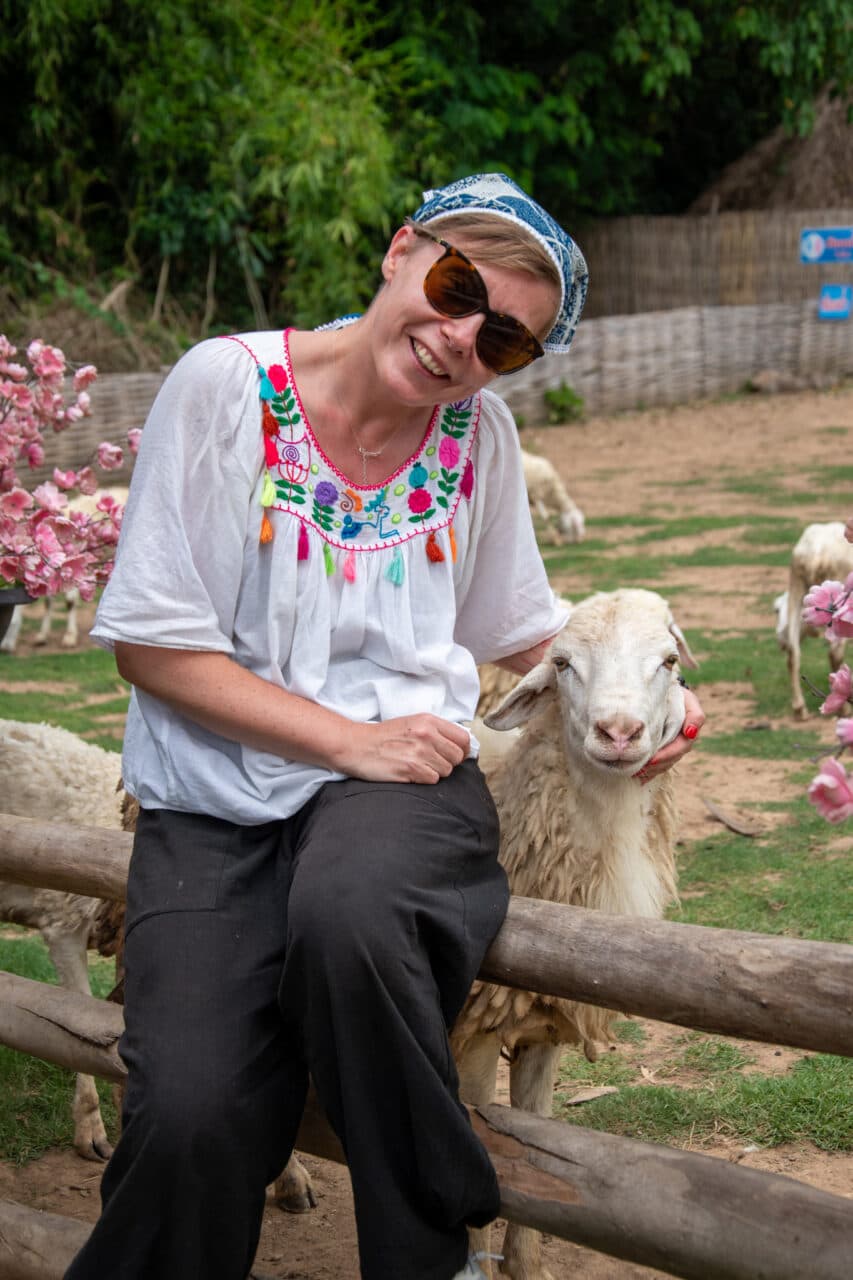
Isaan is a region that’s really very quiet. Most of the people here are farmers, and the land is made up of farmland and forests. There aren’t that many cars on the roads. Scooters are far more common, and the routes wind through sleepy, peaceful villages.
Don’t expect big attractions, though. There isn’t all that much of that around Chiang Khan. There are no waterfalls or caves here. Every now and then you’ll come across a turn-off to a river beach, but when I was there, every bar along them was closed. This area is perfect for taking your time – lazily riding around the roads and drinking coffee in Chiang Khan.
In the morning, while the sun was still hiding behind the clouds, I went to see the Chiang Khan Skywalk. It was clear right away that this was a big undertaking. Right at the entrance, there was a huge car park planned out, along with shops, a market, and restaurants. Someone clearly wanted to turn this into a major success, but during my visit, it looked like they’d overestimated things. Maybe there are more people there in winter, but at the time, the place was practically empty.
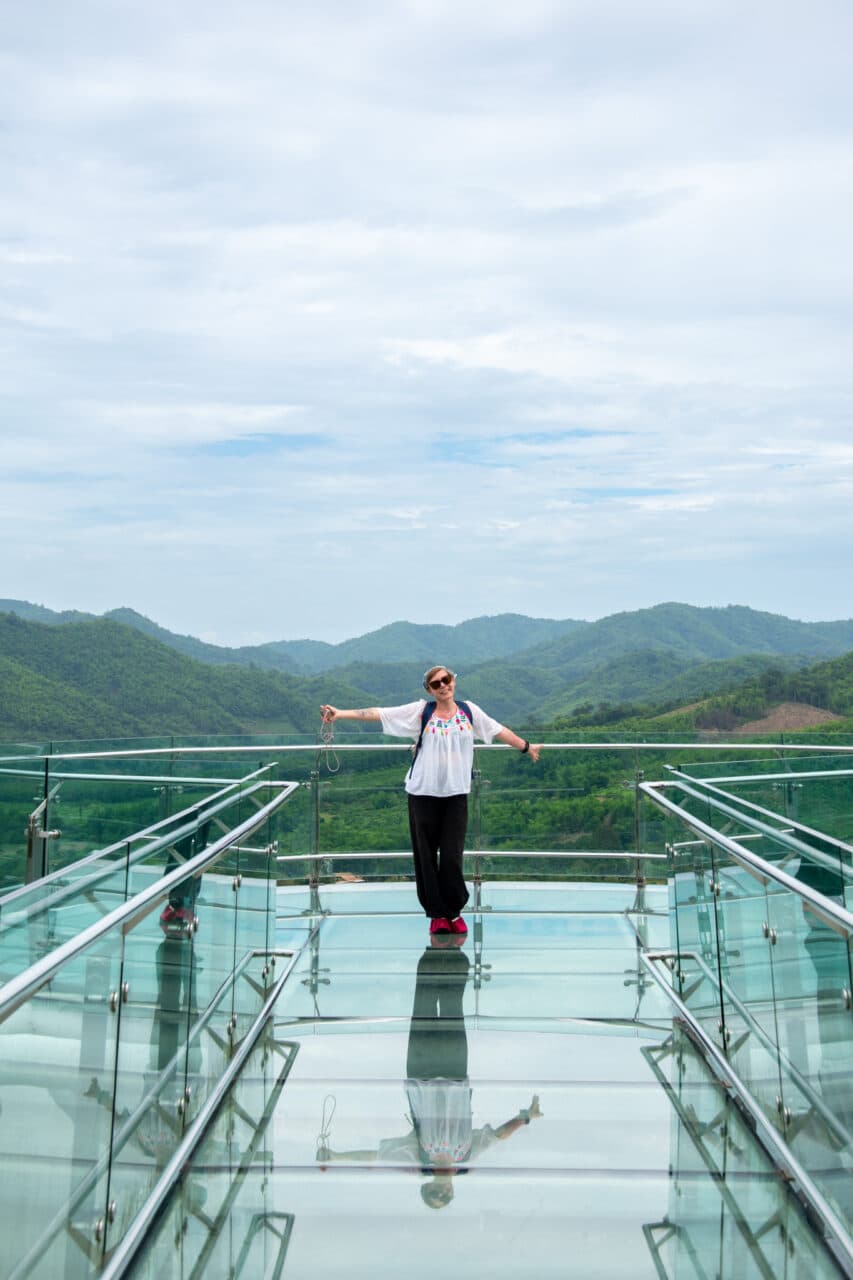
I left the scooter and went to buy a ticket. I paid 60 THB and got into a songthaew, which took me up to the top of the mountain. There, next to a huge standing Buddha, I was given special slippers and could walk out onto the viewing platform.
The whole structure is made of steel and has a see-through floor, so it might not be for those afraid of heights. From the top, you can see the hills and the river winding below. It’s a beautiful view, and a great place to catch your breath from sightseeing, or from driving a scooter or car along these roads.
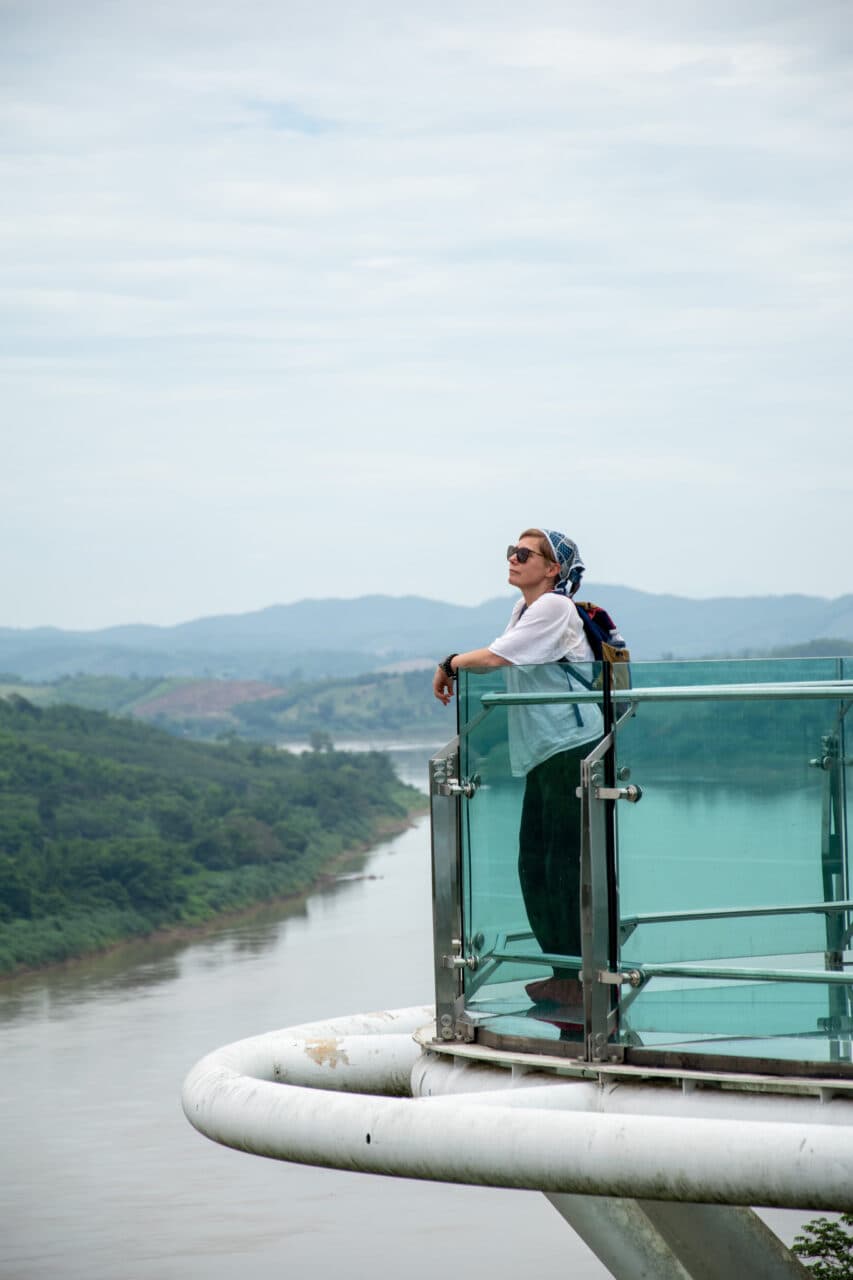
I was looking around for something different too – places by the water where I could rest. I found a few beaches that were supposed to have restaurants and seating areas. It turned out, though, that everything was closed, and the huts that had once stood by the river were completely wrecked, blocking the way down to the water. After a few attempts at reaching similar spots, I stopped at a small food stall, where a small, lively old woman made me a delicious pad see ew.
Afterwards, I stopped by the nearby Phu Chang Noi temple. Stairs lead up to it, guarded by the legendary Naga – a serpent that wards off evil spirits. At the top there’s a tiny shrine with a large seated Buddha. From there, a beautiful view stretches out over the surroundings. It’s also a great spot for sunset. Only one monk lives at the temple. I was the only visitor there, and I don’t think many people make it out that way, because the gardener thanked me warmly for coming.
The morning blessings at the neighbours’ house
At 5am I was woken up by loud music. If you’ve never heard music from the Isaan region, brace yourself. It’s not something you immediately think of as a masterpiece. I can appreciate it now, though it wasn’t always that way, but playing any track at 5am borders on cruel and unusual punishment. My hotel’s neighbours clearly didn’t see it that way.
I was going to have to get up anyway, I thought. I got dressed, grabbed my camera and went to see the alms-giving to the monks I’d mentioned earlier. I walked between the houses for almost two hours and came back to the hotel. Outside, across the street, a strange ceremony was underway.
A huge table had been set up right in the road, practically sagging under the weight of fruit, flowers and sweets. Beside it stood a painting showing, as far as I could tell, some kind of goddess by a river. People were milling around, talking, taking photos, laughing. In front of the table, a beautiful middle-aged woman was performing strange dances. The music was still playing.
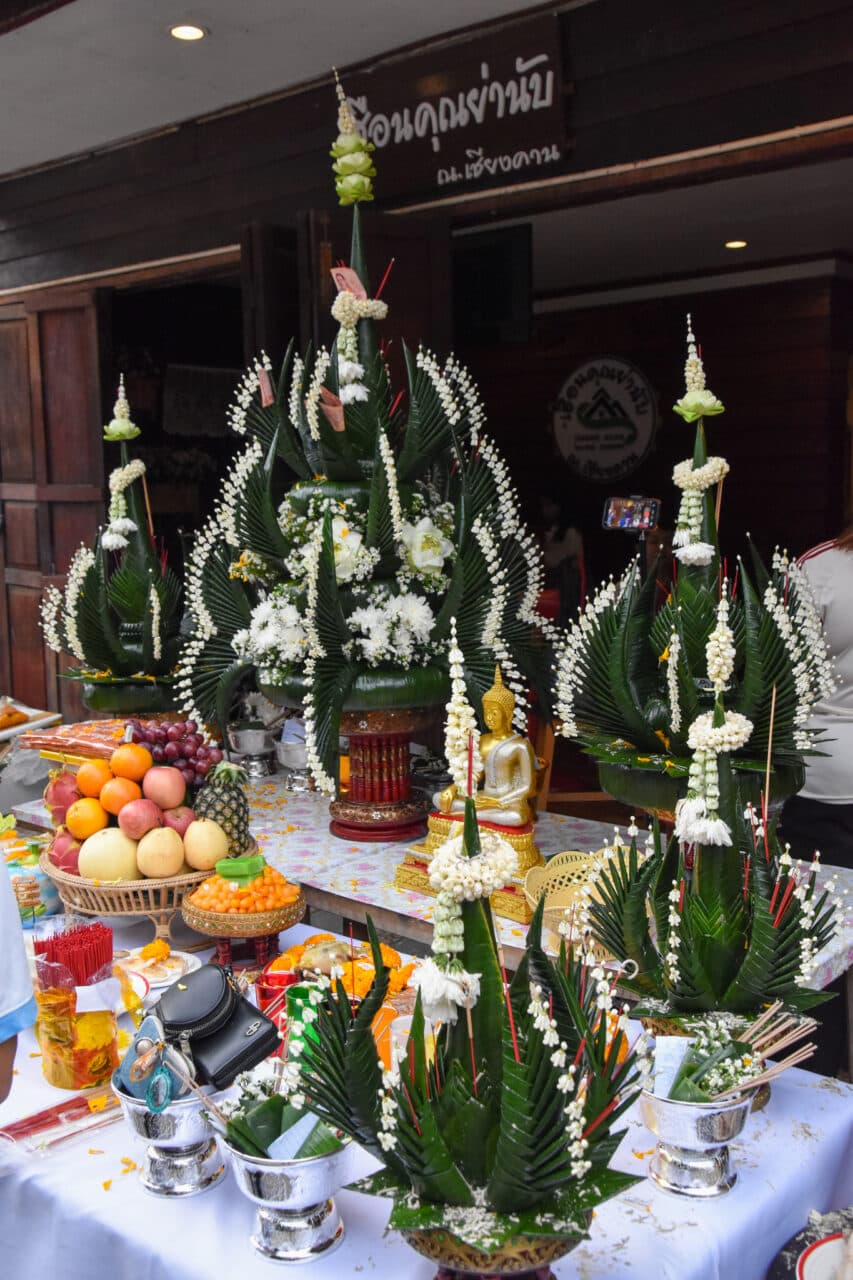
I went closer to see what was going on. A few minutes later, the receptionist from my hotel came out, and in simple Thai I gathered that the neighbouring family had given a painting to the temple and were now asking for it to be blessed. The ceremony was set to last three mornings.
Religion in this part of Thailand is mostly Buddhist, but with plenty of animist elements and influences from Laos. This particular ceremony was dedicated to a water goddess, meant to bring the household happiness and prosperity. The owners ran a small hostel and were praying for many new guests. The whole family had been invited to the celebration. Even the owner’s son had come specially from Bangkok. There was also a former monk present – a layperson known for their wisdom and knowledge of the scriptures, who is qualified to conduct ceremonies like this one. A similar man also officiated my own wedding to my husband near Chiang Mai.
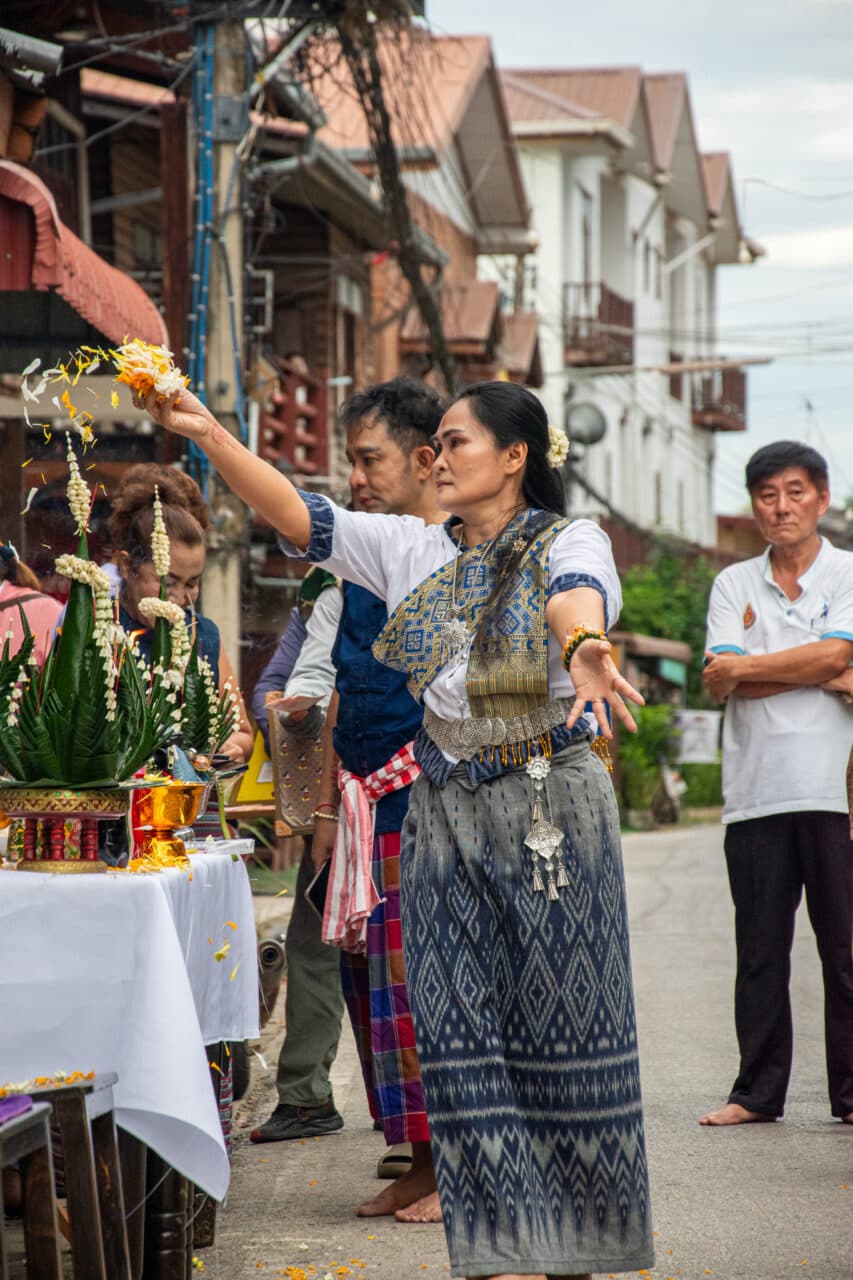
The family invited me inside. Once again, I found myself invited to take part in something culturally foreign to me, yet so beautiful. I received the blessing, and at the end the monk offered me his own bracelet – which caused quite a stir, since apparently he’d never done anything like that before.
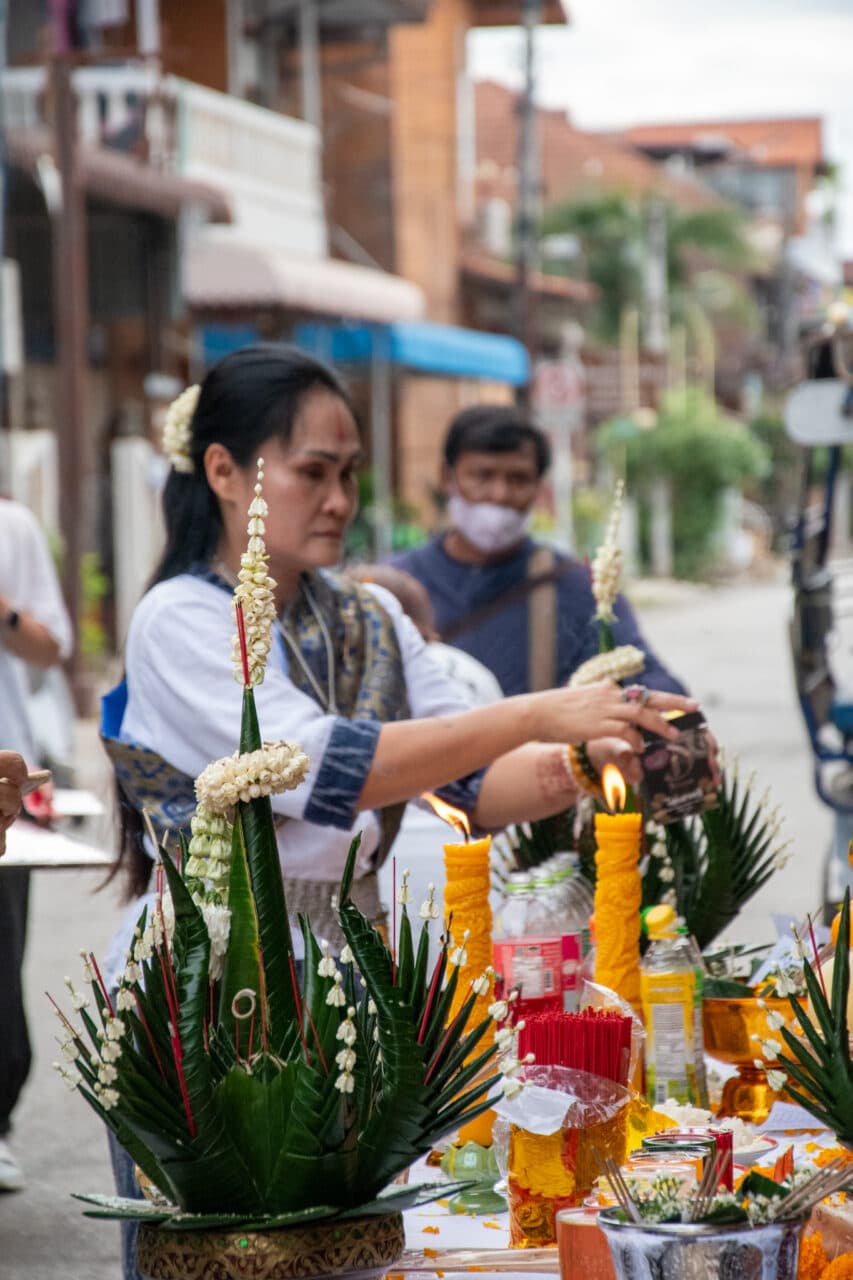
This beautiful ceremony proved to me, once again, that it really is worth learning about Thailand, and getting to know it this deeply.
150th city anniversary and a beautiful parade
That same afternoon, I was pulled out of my nap by loud music again. I was convinced it was the neighbours once more. So I stepped out onto the balcony. To my surprise, out on the street, young people were lining up, beautifully dressed in traditional clothing from the region.
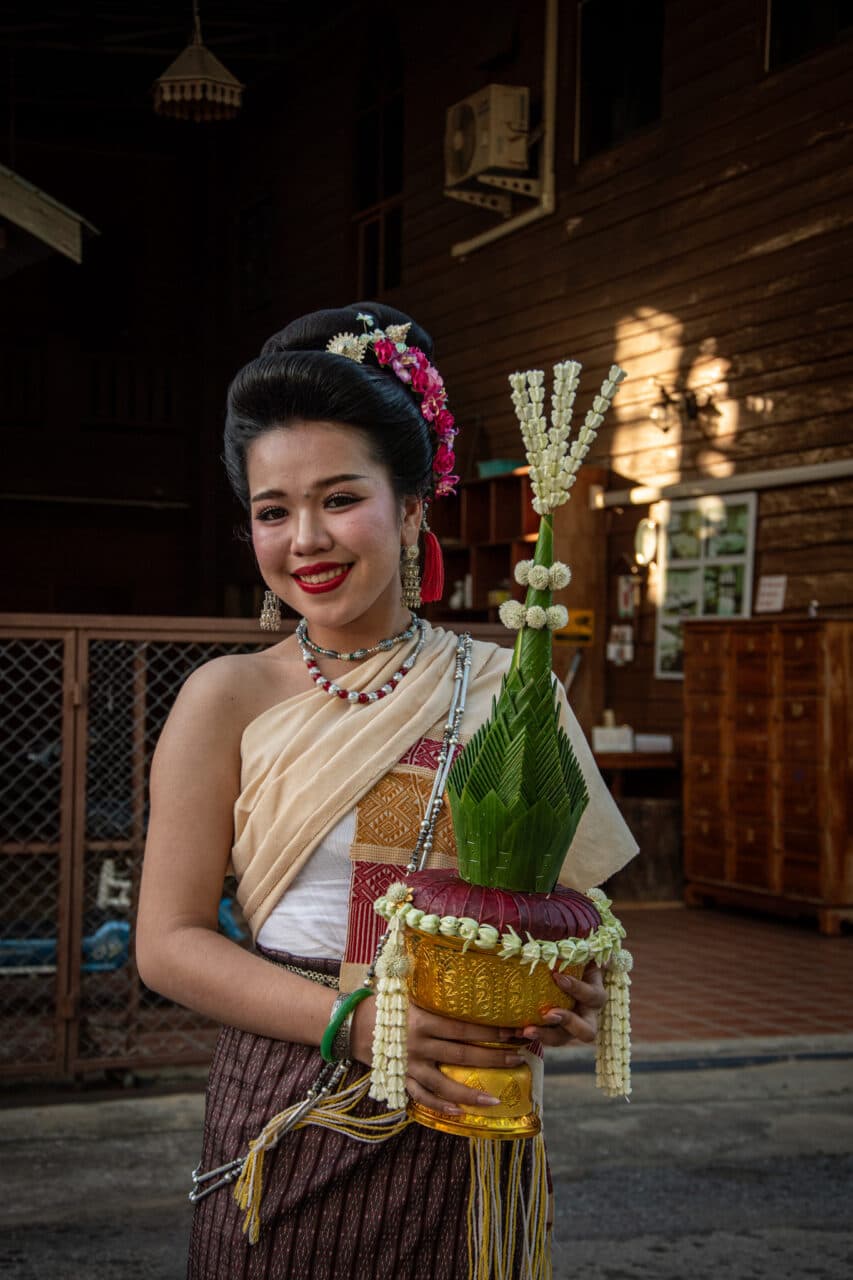
I grabbed my camera and went down. I immediately started photographing the participants in this procession, with no idea at all what was actually going on. It was only a quick Google search that told me Chiang Khan was celebrating its 150th anniversary that very day, and the parade that was just starting would end at the river with the releasing of krathongs.
A krathong is a kind of wreath, made from flowers in various colours. You’ll see the most famous krathongs in Chiang Mai during Loi Krathong – the festival of light in November. Krathongs are released onto a river or the sea. It symbolises letting go of bad thoughts and negative energy, and inviting good things into your life.
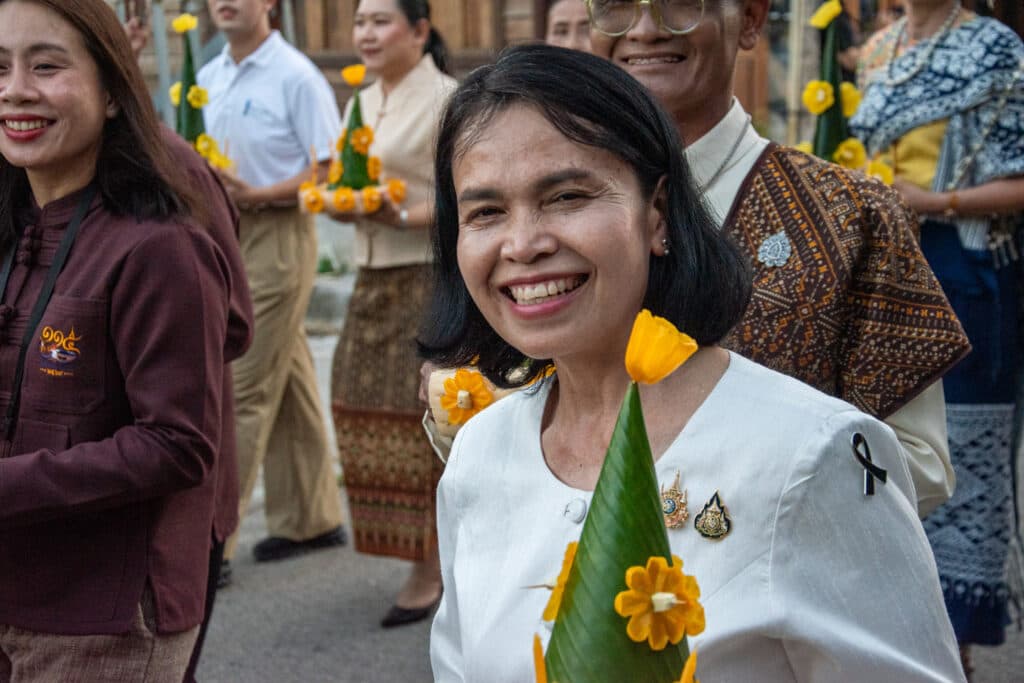
In Chiang Khan, the krathongs take the form of pyramids – cones made from banana leaf and white flowers. That day, they were carried down to the river by beautifully dressed women in Lanna costume. In northern Thailand, this clothing isn’t just a sign that these areas were once autonomous, separate kingdoms – it’s still worn here, not only during festivals. During my time working at a Thai school, I wore Lanna dress on Fridays too.
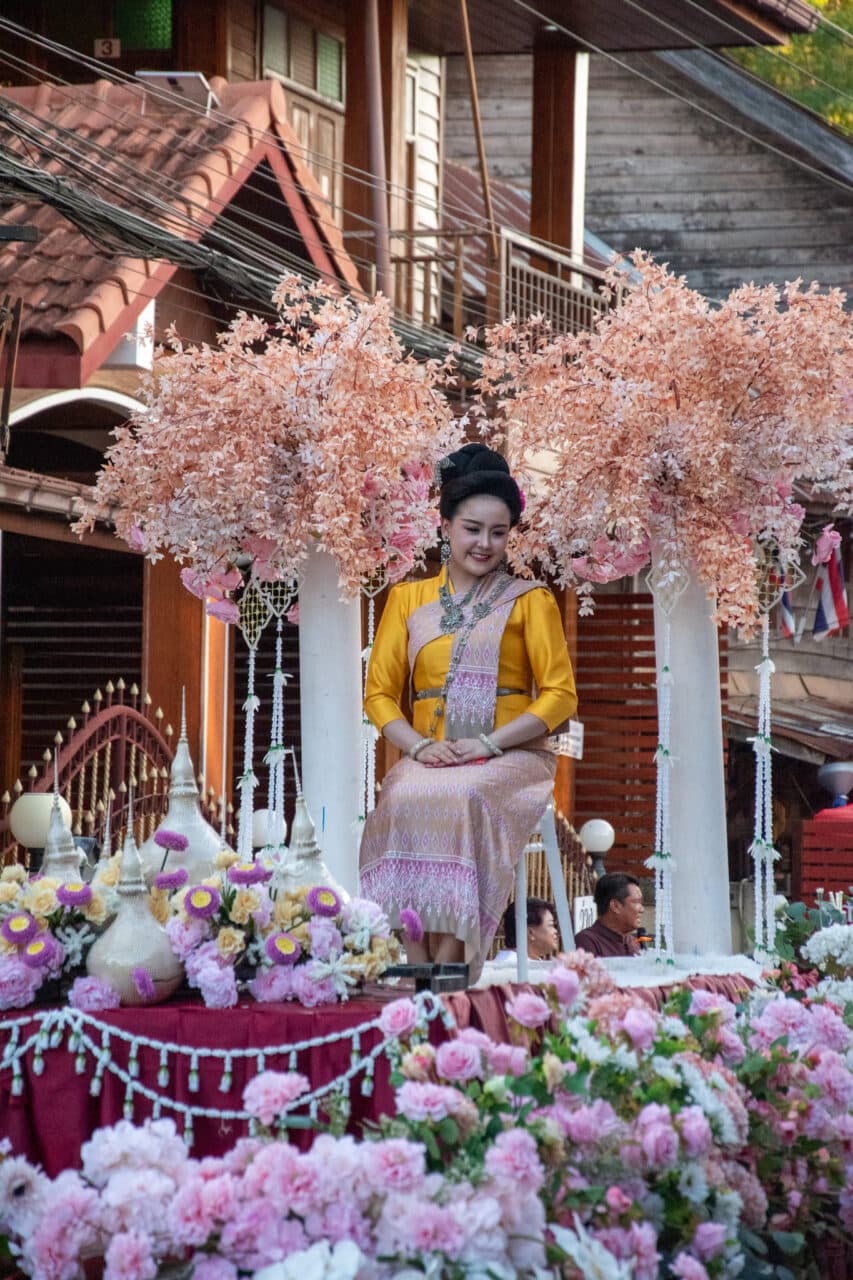
The parade, about a kilometre long, made its way down the main street and reached the river. There, participants set their krathongs on the water. About an hour later, concerts and firework displays began, but worn out from the day’s events, I didn’t stay until the end.
Chiang Khan – Practical Information for visitors
When and how long to go?
I visited Chiang Khan in mid-June, and it was extremely hot and humid. Honestly, there wasn’t much I could do during the day at that time. I think December-January would be better months to visit. I spent 4 days in the town, and that was plenty of time for me.
How to get to Chiang Khan?
The best option is to fly from Bangkok to Loei, from where buses run regularly. If you’re coming from Bangkok, set off as early as possible to make sure you catch the onward connection. There are also taxis outside the airport. Getting to Chiang Khan should cost around 2,000 THB. You can check bus tickets and connections on 12GoAsia.
Accommodation – Where to stay?
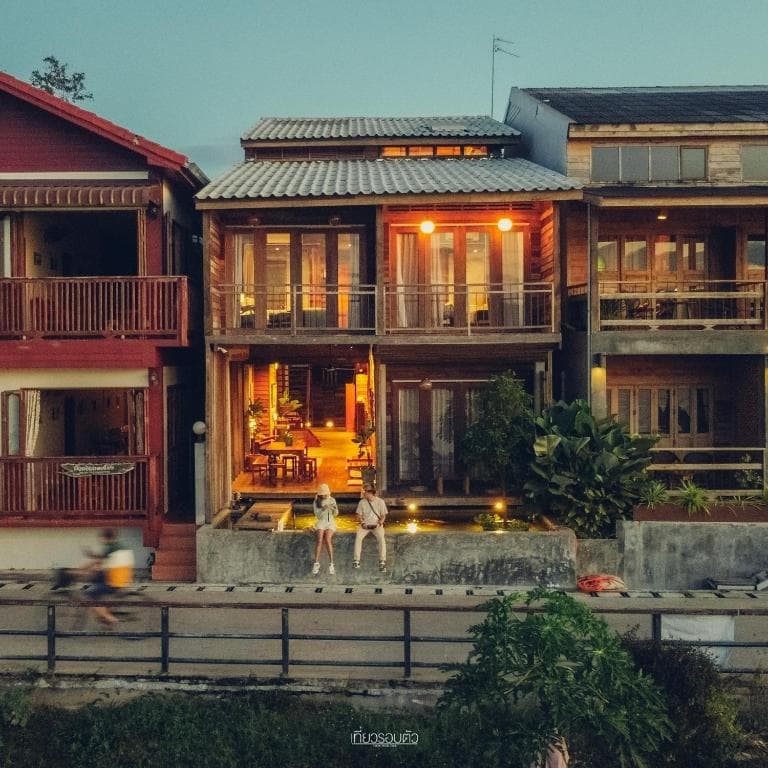
I’d recommend staying in the centre of Chiang Khan, somewhere along the main street that cuts through the old town. There are plenty of nice hostels and hotels there, comfortable and reasonably priced. I’d highly recommend Suneta Hostel, where I stayed myself. There are two properties in town and both are lovely.
Where and what to eat?
There are plenty of good places to eat in town. If you don’t mind getting up very early, you’ll find street vendors out around 6-7am. Grab some grilled sticky rice with egg from them (a local speciality), along with some grilled meat. Some sandwich-and-coffee spots stay open until around 9am. If you’re not an early riser, just book accommodation with breakfast included.
After 9am, at least during both the rainy and dry seasons, a lot of businesses close up until evening. A few places along the river sometimes stay open. It’s only in the evening that Chiang Khan really comes alive. Make sure you head to the night market then – there’s a genuinely huge amount of food to choose from. Another local speciality is grilled seafood, which you’ll find on pretty much every corner. Also worth trying is Isaan/eastern-style cuisine – som tam salads (try the Luang Prabang version), moo nam tok, or grilled fish.
SafetyWing — best if you travel often
SafetyWing’s Complete plan covers outpatient care, screening, medication and maternity — plus lost luggage, cancelled flights and stolen electronics, wherever you are. Claims are processed in as little as 48 hours.
Get a SafetyWing quoteChiang Khan – FAQs
Is it worth visiting Chiang Khan? Yes, if you’re after a quieter side of Thailand – far fewer tourists than Chiang Mai or the islands, genuine local life, and views over the Mekong. This isn’t a place for ticking off attractions one after another, just for slowing down.
Is Chiang Khan better than Pai? I would say that if you’re looking for more local life and genuine, then Chiang Khan will be a better choice. I saw some foreigners here, but they were mostly expats. At the moment Chiang Khan is visited more by Thai tourists.
How many days are enough for Chiang Khan? 2-3 days is the minimum, to see the old town, the night market, and take a scooter trip out to the viewpoints. I stayed 4 days and wasn’t bored for a moment – it’s the kind of place where it’s easy to slow down and stay longer than planned.
How do you get to Chiang Khan? The most convenient way is an overnight bus from Bangkok, or a flight to Loei (LOE) followed by a transfer. You can also get there from Chiang Mai or Dan Sai, though that’s a longer route through the mountains.
What’s the difference between Chiang Khan and Chiang Mai? The names sound similar, but they’re completely different places. Chiang Mai is a large northern city with an international airport and crowds of tourists. Chiang Khan is a small riverside town in the Isaan region – intimate, quiet, and little known among foreign travellers.
Can you rent a scooter in Chiang Khan? Yes, there are scooter rentals in the centre of the old town, and it’s the best way to reach the Mekong viewpoints and the harder-to-reach corners outside town.
When’s the best time to visit Chiang Khan? From October to March – mornings by the river are cooler and more pleasant then, making it the best time for walks through the old town and the night market.
🌴 Complete Thailand Travel Plan
4 Routes in One Place – 2 Weeks
Can’t decide between Krabi, Phuket, Koh Tao or eastern islands? Now you don’t have to choose – you get all 4 options with complete itineraries!
✨ Bangkok → Chiang Mai + 4 beach options
✨ 206 pages | Day-by-day itinerary | Hotels | Restaurants | Transport | Budgets
💡 Or choose a specific route:
This post includes affiliate links.